
Tutorial : bragg configuration - general - effect of an acoustic frequency change on the diffraction efficiency
Bragg conditions
Let consider a plane wave illuminating a grating with an incident angle θi = 0. The optical wavelength is considered much smaller than the grating pitch and the diffraction angle in the order p is considered small as well as the grating thickness d. The phase shift between the wave diffracted in the order p at the grating entrance and the one diffracted at the grating output is :
 .
.
 .
Consequently, the interference become destructive in the order p for a thickness :
.
Consequently, the interference become destructive in the order p for a thickness :
 .
For a thickness larger than Lc, the efficiency in the order p is significantly decreasing. The formula shows that Lc decreases with the order. Thus, increasing the grating thickness makes the diffraction orders disappear starting from the higher order.
Let us take advantage of this paragraph to mention that for acousto optics, the thickness
.
For a thickness larger than Lc, the efficiency in the order p is significantly decreasing. The formula shows that Lc decreases with the order. Thus, increasing the grating thickness makes the diffraction orders disappear starting from the higher order.
Let us take advantage of this paragraph to mention that for acousto optics, the thickness 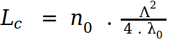 is generally considered as the critical interaction length. It corresponds to the distance covered by a wave propagating perpendiculary to the acoustic wave for running through half of an acoustic wavelength in the transverse plane ( plane perpendicular to the light wave propagation ) because of the diffraction. Indeed, at a given time, the acousto optic can be schematized as a succession of low index and high index zones of thickness
  . The optical wave can be therefore considered as diffracted by FORMULA thick slits. The Raman-Nath regime can only occure if the interaction length is far below Lc.
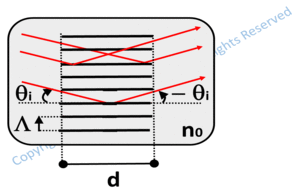 Back to gratings, for an incidence angle θi, the amplitude of the wave diffracted in the order p is :
 .
.
 .
A0 ( θp ) is the amplitude of the wave diffracted in the order p per unit length.
.
A0 ( θp ) is the amplitude of the wave diffracted in the order p per unit length.
This shows that if  , the grating is considered thin and several orders can be diffracted (see "Raman-Nath" section).
If the thickness increases, the diffraction efficiency decreases for all orders except for the one verifying the following equation :
, the grating is considered thin and several orders can be diffracted (see "Raman-Nath" section).
If the thickness increases, the diffraction efficiency decreases for all orders except for the one verifying the following equation :
 .
This applies for the order 0 and the order p where
.
This applies for the order 0 and the order p where 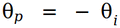 . This condition is called the Bragg condition. The absolute value of the incident ( and diffracted ) wave is then :
*
. This condition is called the Bragg condition. The absolute value of the incident ( and diffracted ) wave is then :
* .
.
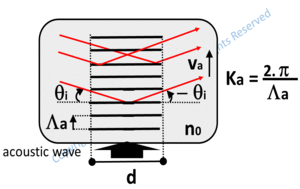 In an acousto optic, the Bragg configuration applies for orders -1 and therefore :
*
In an acousto optic, the Bragg configuration applies for orders -1 and therefore :
* .
As the grating is moving at the acoustic wave velocity, there is a frequency shift of the diffracted wave given by :
.
As the grating is moving at the acoustic wave velocity, there is a frequency shift of the diffracted wave given by :  .
The efficiency in the bragg conditions is :
.
The efficiency in the bragg conditions is :
 .
.
A maximum efficiency of almost 100% is obtained for 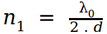 .
The acoustic intensity is then :
.
The acoustic intensity is then :
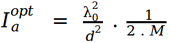 .
For an incidence angle close to the Bragg angle, the efficiency of the diffracted wave is :
.
For an incidence angle close to the Bragg angle, the efficiency of the diffracted wave is :
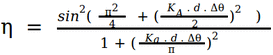 .
The angular acceptance Δ θ of the acousto optic is defined as the angle variation referred to the Bragg angle for which the efficiency drops to 50% (3 dB).
It is :
*
.
The angular acceptance Δ θ of the acousto optic is defined as the angle variation referred to the Bragg angle for which the efficiency drops to 50% (3 dB).
It is :
* Also, the frequency bandwidth Δ Fa is defined as the frequency variation referred to the exact frequency in Bragg configuration inducing an efficiency drop of 50% (3 dB).
Δ Fa is given by the formula :
Also, the frequency bandwidth Δ Fa is defined as the frequency variation referred to the exact frequency in Bragg configuration inducing an efficiency drop of 50% (3 dB).
Δ Fa is given by the formula :
 .
(*) the angles are calculated in the acousto optic material. The Fresnel law must be applied to them to calculate the corresponding values in the air.
.
(*) the angles are calculated in the acousto optic material. The Fresnel law must be applied to them to calculate the corresponding values in the air.