Tutorial : axial and height chomatisms - object at infinity - thin lens
Chromatic aberration
Another type of aberration than geometric aberrations exists for optical systems including refractive components. It is the chromatic aberration which is depending on the refractive materials used. Unlike geometric aberrations, chromatic aberration, occurs also in Gauss
conditions for objects close to the axis and rays with direction close to the optical axis direction.
Unlike reflective components, refractive components generally contain a dispersive material (which refraction index depends on the wavelength). The same incident ray
is refracted differently at the component interface depending on the wavelength. Consequently, the paraxial conjugation is different depending on the wavelength. Practically, if the object is illuminated by a polychromatic light source, it has as many images as
wavelengths contained in the light source spectrum. Therefore, whatever the position of the observation plane, the image of a point is an iridescent spot and the image of a scene can be blurred with coloured outlines.
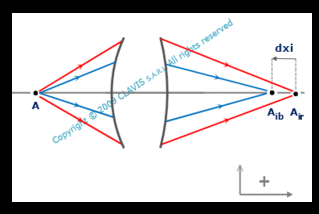 Considering an optical system and an axial object A illuminated with a polychromatic light source, the axial chromatism (or longitudinal chromatism) is defined as the algebric distance dxi
from Air to Aib, Air and Aib being the conjugated
points respectively for the largest and the smallest wavelengths of the light source spectrum.
Considering an optical system and an axial object A illuminated with a polychromatic light source, the axial chromatism (or longitudinal chromatism) is defined as the algebric distance dxi
from Air to Aib, Air and Aib being the conjugated
points respectively for the largest and the smallest wavelengths of the light source spectrum.
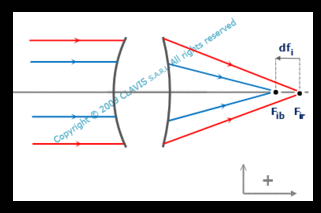 The principal axial chromatism corresponds to the case where the object is at infinity. Therefore, it is the algebric distance dfi from Fir to Fib,
Fir and Fib being the back focal points respectively for the largest and the smallest wavelengths of the
spectrum.
The principal axial chromatism corresponds to the case where the object is at infinity. Therefore, it is the algebric distance dfi from Fir to Fib,
Fir and Fib being the back focal points respectively for the largest and the smallest wavelengths of the
spectrum.
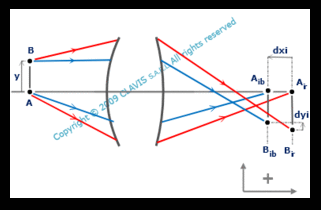 Obviously, the chromatism affects also the off-axis conjugation. As the position of the image plane changes with the wavelength, the conjugated of an off-axis object is at a different height depending on the wavelength and thus the magnification also changes depending on the wavelength. The height chromatism dyi for an off-axis object
B is defined by the algebric height difference
between Br and Bb,
Br and Bb being the paraxial images of B respectively for the largest and the smallest
wavelengths of the spectrum. The height chromatism is currently called lateral colour.
Obviously, the chromatism affects also the off-axis conjugation. As the position of the image plane changes with the wavelength, the conjugated of an off-axis object is at a different height depending on the wavelength and thus the magnification also changes depending on the wavelength. The height chromatism dyi for an off-axis object
B is defined by the algebric height difference
between Br and Bb,
Br and Bb being the paraxial images of B respectively for the largest and the smallest
wavelengths of the spectrum. The height chromatism is currently called lateral colour.
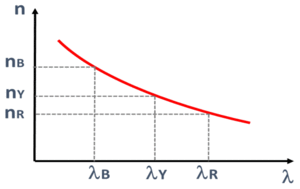 The constringence (or Abbe number) characterizes the dispersion of a material. The dispersion is the variation of refractive index regarding the wavelength. The constringence is given by
 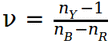 where nB and nR are the refraction indexes of the lens material respectively for the lowest and the highest wavelength of the spectrum, nY being the refraction index at an intermediate wavelength. As the refraction index decreases with the wavelength, the constringence is positive. Its values is in general between 20 and 100 in the visible spectral range.
In the visible, the constringence ν is commonly calculated using 486.13 nm (blue hydrogen line) and 656.27 nm (red hydrogen line) as the lowest and highest wavelength as well as 589,3 nm (yellow sodium line) as the intermediate wavelength. It is also calculated with other sets of wavelengths. Indeed, νd uses the same extreme wavelengths than ν but the intermediate wavelength is 587,56 nm ( yellow helium line ). νe is calculated using 480.0 nm (blue cadnium line) and 643.8 nm (red cadnium line) as the lowest and highest wavelength as well as 587,56 nm (mercury line) as the intermediate wavelength. One can divide the materials in two categories. The higher is the constringence, the less dispersive is the material. A material is usually considered to have a low dispersion when its constringence is higher than 50 and a high dispersion when its constringence is lower than 50.
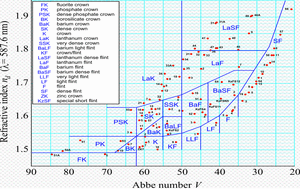 The figure on the left (Source WIKIPEDIA), called Abbe Diagram, represents the constringence (or Abbe number ) regarding the wavelength for glasses labelled with the SCHOTT manufacturer code. It is very useful when designing an optical system supposed to work at different wavelengths as it gives an idea of the refractive index values and of the constringence.
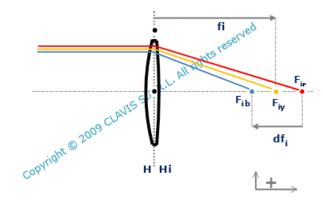 For a thin lens, the principal axial chromatism is
 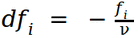 where fi is the back focal length and ν is the constringence. Therefore, it is negative for a positive lens (converging lens) and positive for a negative lens (diverging lens). This is easily explained by the fact that as the refraction index decreases when the wavelength increases, the rays at short wavelength are more deviated than the rays at long wavelengths. Accordingly, focal lengths are shorter at short wavelengths than at long wavelengths.
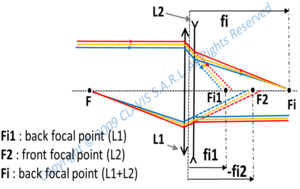 As positive and negative lenses have opposite axial chromatism, one can obtain a system corrected from the chromatism by using two thin lenses ( L1 and L2 ) placed side by side. If L1 is converging, its chromatism is negative and can be compensated by the positive chromatism of the diverging lens L2. Given the focal length of the system, the respective focal lengths of L1 and L2 are calculated as follows :
 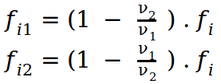 .
.
The system is called an achromat. According to the formula, the constringences of L1 and L2 must be different and thus the two lenses have to be manufactured with different materials. L1 has to be less dispersive than L2.
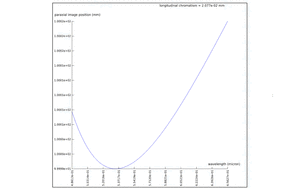
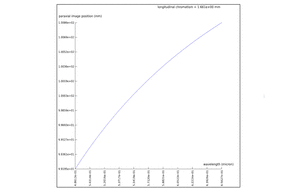 The left side curve on the left shows the principal axial chromatism (also called focal shift) of an achromat with a focal length of 100 mm. It is made with a converging lens L1 (fi1=50 mm, ν1=60) and a diverging one L2 (fi2=-100 mm, ν2=30). This curve has a minimum which means that the focal length is the same for two different wavelengths. It is obviously different from the right side curve representing the principal axial chromatism of a single lens with the same focal length and a constringence of 60. Even if it is not null, The achromat focal shift in the visible spectrum is significantly smaller than for the single lens ( about 8 times smaller in the present case).