Tutorial : elliptical beam - direct coupling
Laser beam
Geometric optics is not sufficient to explain light emission by a laser. Electromagnetic theory with limit conditions given by spatial and phase stabilities after one round trip in the cavity impose that only specific waves can oscillate. They are called the transverse modes of the laser. In Gauss conditions, they are solutions of the Maxwell equation in isotropic media using the paraxial approximation :
 .
Among others, these waves depend on the mirrors shape and their relative positions. Different models exist depending on the cavity. The models pedict modes with different kinds of intensity distributions. If the mirrors have a rectangular symetry, Hermito gaussian modes may propagate. The amplitude of the Hermito Gaussian mode Hpq is given by :
.
Among others, these waves depend on the mirrors shape and their relative positions. Different models exist depending on the cavity. The models pedict modes with different kinds of intensity distributions. If the mirrors have a rectangular symetry, Hermito gaussian modes may propagate. The amplitude of the Hermito Gaussian mode Hpq is given by :
 .
.
 is an Hermite polynomial.
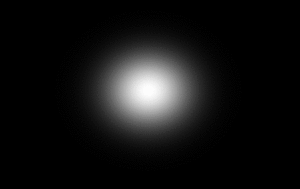
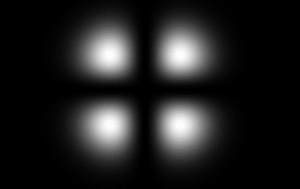
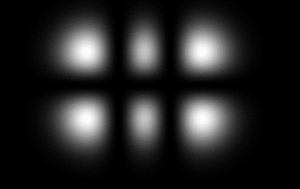
The intensity distribution of Hermito gaussian modes H00, H11, H21 and H22 are illustrated below.
is an Hermite polynomial.
The intensity distribution of Hermito gaussian modes H00, H11, H21 and H22 are illustrated below.
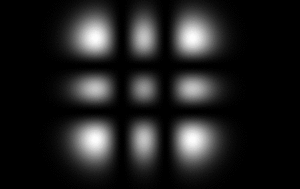
In cavities with a cylindrical symetry, Laguerre gaussian modes may propagate. The amplitude of the is given by the formula below :
 .
.
 is a Laguerre polynomial.
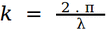
Among all the modes, the fundamental mode (common to Hermito gaussian and Laguerre Gaussian modes) is also called TEM00 mode or gaussian mode because its intensity distribution in a transverse plane XY perpendicular to the propagation has a gaussian shape. Its amplitude distribution is :
is a Laguerre polynomial.
Among all the modes, the fundamental mode (common to Hermito gaussian and Laguerre Gaussian modes) is also called TEM00 mode or gaussian mode because its intensity distribution in a transverse plane XY perpendicular to the propagation has a gaussian shape. Its amplitude distribution is :
 .
.
 ,
,  ,
,  ,
,  ,
, 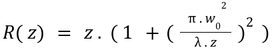 .
R(z) is the radius of curvature of the wave front at the distance z from the waist.
The intensity is:
.
R(z) is the radius of curvature of the wave front at the distance z from the waist.
The intensity is:
 .
.
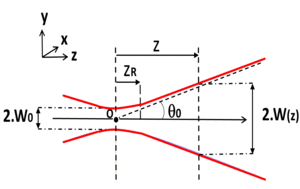
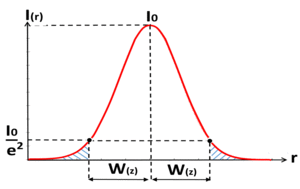 Whatever the transverse plane, the beam is commonly delimited by the circle for which the relative intensity is 1 / e2 and therefore containing 86,5% of the light power. This circle diameter is 2 .w(z) and is defined as the beam diameter at the considered position on the propagation axis. The beam diameter changes along the propagation axis and forms an hyperboloidic envelope . The beam half divergence is
 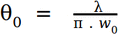 . The origin O of the propagation axis is taken on the waist where the beam cross section is the smallest.
The half diameter of the waist is w0.
The Rayleigh range defined by 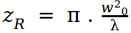 is a characteristic parameter of the beam.
if
is a characteristic parameter of the beam.
if  , the considered zone is commonly called the "near field " and
 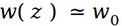 . The wavefront shape is rather flat.
if
. The wavefront shape is rather flat.
if  , the considered zone is commonly called the "far field" and
  . The beam is diverging and the wavefront is spherical and approximately centered on the waist center.
The fundamental mode is the less diverging mode and thus it has the highest spatial coherence. Therefore, most laser suppliers try to manufacture lasers emitting in the fundamental mode only.
In reality, laser beams can never be exactly gaussian, first because the involved theory is an approximation in the paraxial conditions, second because the cavity is not prefect (mirrors shape and positionning are not exactly as designed) or simply because the beam can not be fully cleaned and it is a combination of the gaussian mode with higher order modes. Whatever the beam, it has a waist (location where its cross section is the smallest) and a divergence which is necessarily larger than the divergence of the theoretical gaussian beam with the same waist radius.
. The beam is diverging and the wavefront is spherical and approximately centered on the waist center.
The fundamental mode is the less diverging mode and thus it has the highest spatial coherence. Therefore, most laser suppliers try to manufacture lasers emitting in the fundamental mode only.
In reality, laser beams can never be exactly gaussian, first because the involved theory is an approximation in the paraxial conditions, second because the cavity is not prefect (mirrors shape and positionning are not exactly as designed) or simply because the beam can not be fully cleaned and it is a combination of the gaussian mode with higher order modes. Whatever the beam, it has a waist (location where its cross section is the smallest) and a divergence which is necessarily larger than the divergence of the theoretical gaussian beam with the same waist radius.
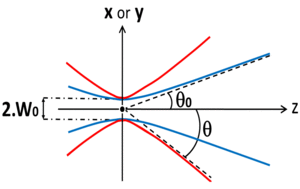 A simple way to modelize the propagation is then to consider the beam as an "embedded" gaussian beam with an hyperboloidic shape and which divergence is given by θ with
 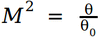 . The M2 factor (or "M-square" factor) is therefore larger than 1. The "embedded" gaussian beam parameters can be calculated using the fundamental mode formulas and replacing
  .
For example, the beam rayleigh range becomes
.
For example, the beam rayleigh range becomes 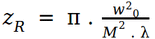 .
.
M2 can be specified smaller than 1.05 for relatively low power lasers and can achieve several dozens for high power lasers. Note that the concept of low or high power is strongly dependant on the technology. For example, Argon lasers can have low M2 (close to 1) with power in the range of 20 W while laser diodes are generally multimode at power of a few Watts and even less.
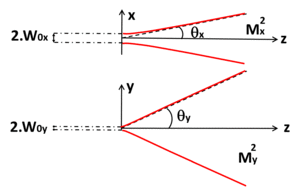 There are cases where the gain medium as well as the mirrors have a rectangular symetry as for instance in semiconductor lasers which gain medium is a parallelipipedic waveguide. The fundamental mode can then be modellized as gaussian in the XZ and YZ planes with different waist dimensions
 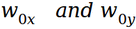 and different divergences
 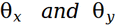 ....
For embedded gaussian beams, the "M-square" factors M2x and M2y are defined respectively in the XZ and YZ planes.
....
For embedded gaussian beams, the "M-square" factors M2x and M2y are defined respectively in the XZ and YZ planes.
Obviously, M2x and M2y can have different values. For example, high power laser diodes made of a single wave guide (emitting few Watts) have a thickness (in the range of hundred microns) very different from the height ( in the range of the micron) and thus the M2y corresponding to the vertical plane is close to 1 while M2x corresponding to the horizontal plane is much higher than 1. Note that all semiconductor lasers don't have astigmatism. For example VCSELs (Vertical Cavity Surface Emitting lasers) can emit beams with a cylindrical symetry.
Fiber optic basics
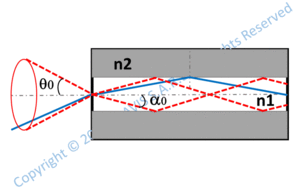 Fiber optics are cylindrical and flexible components guiding light. They are made of a cylindrical core surrounded by a concentric cladding. The refraction index of the core (n1) is larger than the refraction index of the cladding (n2) so that total reflexion can occure at the core/cladding interface. Indeed, total reflexion happens for rays propagating in the core and contained in the cone centered on the optical axis and which half angle is :
 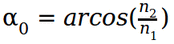 .
.
Therefore, rays contained in this cone may be guided in the fiber optic.  is the numerical aperture and defines the acceptance angle
  .
.
θ0 is different from α0 because of the refraction at the fiber entrance (interface air/core). Note that the formula defining the numerical aperture is suitable for multimode fibers only, the numerical aperture for single mode fibers being defined with the half divergence angle of the gaussian beam with the fiber mode diameter wf (see section below).
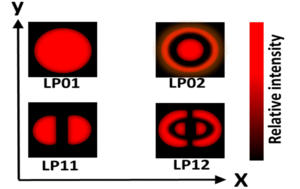 While Total reflexion is a basic and intuitive approach, it is nonetheless unsufficient to explain light wave guiding in fiber optics. To understand light propagation in fiber optics, it is necessary to consider light as an electromagnetic wave. Electromagnetic equations solved with adequate boundaries conditions at the core/cladding interface show that only some specific waves can propagate along the fiber. They are the fiber optic modes and are named LPmq modes. m corresponds the number of intensity minima along the azimuthal axis, while q is the number of intensity minima along the radial axis. Among all possible modes, one specific mode is called the fundamental mode (corresponding to LP01 mode) which is detailed further in this tutrorial. The graphic nearby illustrates schematically the relative intensity of a few low order modes.
One important parameter to charcacterize the fiber optic at a given wavelength is the normalized frequency :
 where R is the core radius and λ is the wavelength. V indicates if the fiber optic is single mode or multimode. Indeed, the fiber optic is single mode if
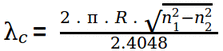
  and multimode otherwise. Single mode means that the fundamental mode only can propagate. Note that a fiber optic is not intrinsically single mode or mutimode. It is single mode for wavelengths above the cut-off wavelength λc and multimode for wavelengths below λc. λc is defined as follows :
  .
.
The normalized frequency V is also suitable to give an approximate value of the number of modes propagating in a highly multimode number :  .
.
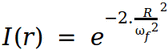
 The intensity distribution of the fundamental mode (LP01 mode which is the unique mode guided in a single mode fiber) is close to a gaussian shape :
  .
.
ωf which is the radius of the fundamental mode can be approximated with following formula :  .
.
ωf is slightly larger than the core diameter. It shows that the fundamental mode propagates mostly in the core but also in the cladding through evanescent waves.
Fiber coupling
Injecting light into a fiber optic is a recurring problem. For a maximum efficiency, the light source etendue has to the as close as possible to the fiber optic etendue. Whatever the optical system used, a quick calculation can give an idea of the maximum coupling efficiency Cmax that can be achieved knowing the respective light source and fiber etendues etens and etenf. In general, the light source etendue is larger than the fiber etendue and : 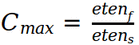 . In the case where etens is smaller than etenf, Cmax = 1. This is for example the case when the light is emitted from a single mode fiber and injected into a multimode fiber which core diameter and numerical aperture (and thus etendue) are much larger.
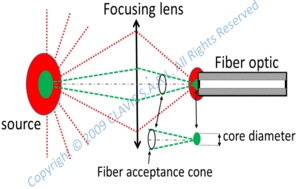 Also, the light source is in general not sufficiently close to the fiber optic for an efficient coupling and an optical system may be necessary to conjugate the light source with the fiber entrance. Only the rays in the fiber acceptance cone coming from a part of the source intercepting the core are injected in the fiber.
An efficient coupling into a single mode fiber can only be achieved with coherent sources (lasers). Indeed, as seen previously, only the fundamental mode LP01 can propagate in a single mode fiber. when propagating in the air, the fiber mode is very similar to a gaussian wave. Therefore, only a gaussian beam is adapted to this wave. Such a spatially coherent beam can be emitted solely by a laser or from a single mode fiber with the same fundamental mode (in which a laser beam has been injected).
In other words, for a maximum coupling efficiency in a single mode fiber, one must use a laser emitting in the fundamental mode only (With a M2 as small as possible). Lasers with large M2 or uncoherent light sources are not suitable for a significant coupling in this kind of fiber optic which core diameter is generally a few microns and numerical aperture is around 0.1 - 0.15. Also, the laser beam has to be shaped in order to fit into the fiber optic core. This means that an optical system may be requested in order to focus the beam waist at the fiber entrance and obtain a beam waist radius as close as possible as the fiber mode radius.
One difficulty when injecting light into a single mode fiber is to focus the laser beam at the exact fiber entrance location. Because the core diameter is very small, the tolerance on the beam positionning is very tight.
Injecting an elliptical beam in a single mode fiber - basic
 As evocated previously, the beam to be injected in a single mode fiber optic should ideally be gaussian. However, laser diodes beam for example do not have a symmetry of revolution. They are elliptical with different intensity
distributions in the vertical and horizontal planes ( respectively YZ and XZ on the scheme).
Spatially coherent laser diodes are assumed to have gaussian intensity distributions in the vertical and horizontal planes with different waists witdth.
Beam emitted by other kinds of laser may also be elliptical, for example after some harmonic generation or other beam processing. In this paragraph, only elliptical beams with gaussian distributions are considered.
As evocated previously, the beam to be injected in a single mode fiber optic should ideally be gaussian. However, laser diodes beam for example do not have a symmetry of revolution. They are elliptical with different intensity
distributions in the vertical and horizontal planes ( respectively YZ and XZ on the scheme).
Spatially coherent laser diodes are assumed to have gaussian intensity distributions in the vertical and horizontal planes with different waists witdth.
Beam emitted by other kinds of laser may also be elliptical, for example after some harmonic generation or other beam processing. In this paragraph, only elliptical beams with gaussian distributions are considered.
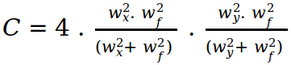
For an elliptical beam which axis coincides with the fiber axis and which waists are located at the fiber entrance, the coupling efficiency is :
 .
.
wx and wy are the waist widths respectively in the XZ and YZ plane. This formula applies for fully coherent beams which means that M2X = M2X = 1.
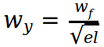
Whatever the optical system used for coupling, an elliptical beam never fits exactly with a fiber optic mode. However, for a given ellipticity 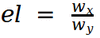 and a given fiber optic, it is possible to define the waist widths for which the coupling efficiency is maximum :
 .
.
In any case, C is low if the ellipticity is large.
Depending on the elliptical beam, it is possible to use the same common coupling configurations than for gaussian beams (direct coupling, coupling with one lens, coupling with two lenses). For beams with a large ellipticity, it may be convenient to use cylindrical or toroidal lenses shaping the beam differently in the XZ and YZ planes and therefore making it gaussian for a better coupling.
In this case, the advantage is also that the waists in each plane can be both focused at the entrance of the fiber while this is not systematic when using spherical optics.
In all cases, as for gaussian beams, the coupling ratio decreases as soon as the defocus increases
or when the beam axis is laterally shifted or tilted.