
Tutorial : Raman Nath configuration - critical interaction length
Raman Nath effect
The Raman-Nath effect applies for a thin acoustic wave. The diffracted wave is then very similar to the one diffracted by a diffraction grating (see "diffraction" tutorial).
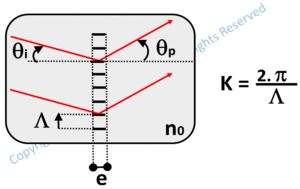 Let consider a transmissive grating with a refraction index
  and a thickness e which is small enough to neglect any propagation effect in the grating. An incident plane wave, is diffracted in several orders (several direction) as shows the diffracted amplitude :
 .
.
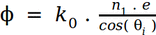 ,
,
 ,
,
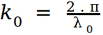 .
λ0 is the wavelength of the optical wave in the air and θi is the incidence angle (in the material) and Λ is the grating pitch (see the scheme on the left side).
The diffracted wave is the superposition of plane waves propagating in the directions θp verifying :
.
λ0 is the wavelength of the optical wave in the air and θi is the incidence angle (in the material) and Λ is the grating pitch (see the scheme on the left side).
The diffracted wave is the superposition of plane waves propagating in the directions θp verifying :
 .
p is the diffration order.
The intensity diffracted in the order p is proportionnal to
.
p is the diffration order.
The intensity diffracted in the order p is proportionnal to  .
.
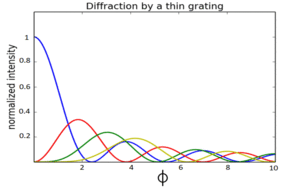 The normalized intensity for the different orders 0 (blue), 1 (red), 2 (green) and 3 (yellow) depending on Φ are represented on the left-side curves. The maximum diffraction efficiency is obtained for the order 1 and can not exceed 33%.
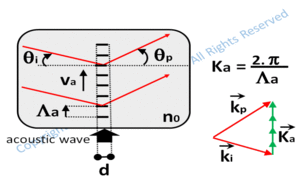 In an acousto optic material, the acoustic wave is travelling. Therefore, the grating is travelling with the same velocity.
The refraction index is then :
In an acousto optic material, the acoustic wave is travelling. Therefore, the grating is travelling with the same velocity.
The refraction index is then :
 .
The amplitude of the diffracted wave is :
.
The amplitude of the diffracted wave is :
 .
.
Because of the conservation of the cinematic moment, the pulsations and thus the wavelengths of the diffracted orders are all different. The pulsation is given by :
 .
If the thickness of the acoustic wave increase, the diffracted wave is the result of intereference from diffracted waves at different positions in the thickness of the material.
.
If the thickness of the acoustic wave increase, the diffracted wave is the result of intereference from diffracted waves at different positions in the thickness of the material.