Tutorial : miscellaneous - depth of field of a collimating and focusing system made of two lenses
Depth of field
In many cases, an optical system is used for imaging an object in a plane and then detect the image. The detector can be for instance a single detector if the object is almost punctual or it can be a matrix of detectors (matrix of pixels) for recording a scene. This last case corresponds to the type of detectors inside a camera. In practice, the object is not exactly at the theoretical position and the detector is not exactly in the conjugated plane. Ideally, a single detector or a pixel is supposed to detect the image of a punctual object. However, its active area can not be punctual.
It makes then no difference when detecting a punctual image or a spot smaller than the active area. Consequently, in a certain limit, both object point and detector can be located in slightly different planes than the respective oject plane and conjugated plane.
This tolerance is commonly called depth of field or maximum defocus depending if the object or the
detector positioning is considered. Considering a punctual object, the depth of field is the tolerance on the object position enabling to obtain a spot in the theoretical conjugated plane which size is smaller than an authorized value. The maximum defocus is the tolerance on the detector position enabling to obtain a spot size smaller than an authorized value, the object being located at its theoretical position.
In practice, depth of field and maximum defocus are smaller than the above mentionned values as both have to be considered at the same time. These tolerances may be complicated to calculate as the ray propagation is not only defined by paraxial conjugation but involves also aberration and diffraction. Moreover, different criterions can be used to define them depending on the considered application.
In the following section, depth of field and maximum defocus are only calculated in Gauss conditions without considering any aberration or diffraction effect. Also, the system is a thin lens and the considered distances are algebraic.
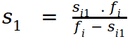
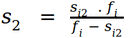
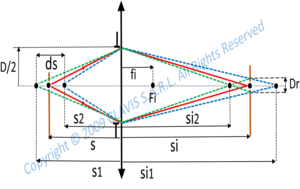 The effective focal length is fi and the aperture diameter is D. Initially, the object and its conjugated are respectively at the distance s and si from the lens. A spot diameter of DR (maximum authorized spot diameter) in the initial conjugated plane is obtained by moving the object in two different positions at the respective distances s1 and s2 from the lens. The corresponding images have then moved and are respectively at the distances si1 and si2 from the lens.
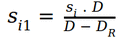 .
and
.
and
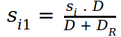 .
According to the paraxial conjugation formulas :
.
According to the paraxial conjugation formulas :
 .
and
.
and
 .
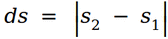
Finally, the depth of field is :
.
Finally, the depth of field is :
 .
.
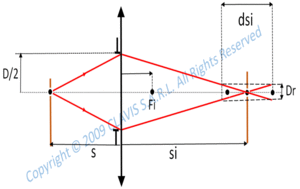 The depth of focus is :
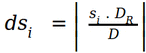 .
.