
Tutorial : two slits interference - size of interfringe and diffraction enveloppe – observation with a lens
Interference basics
Interference can occur when multiple light waves overlap. Lets take the example of a collimated laser beam going through two slits S1 and S2 (Young slits experiment). The slits divide the beam in two beams and are thin enough to diffract the beams sufficiently so that they can overlap. A succession of dark and bright bands called fringes can then be observed on a screen in the overlap zone. These are intereferences. A typical interference pattern obtained with two slits is illustrated below.
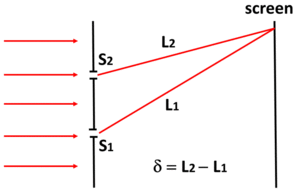
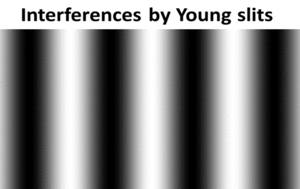
In general, let consider two waves with respective amplitude E1. and E2. at a point M. of the space (E1 and E2 are the amplitude vectors of the electromagnetic fields of the considered waves).
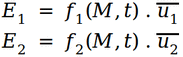 where f1(M,t) and f2(M,t) are depending on the time t and on the position M. u1 and u2 are normalized vectors.
If u1 and u2 have close enough directions, the resulting intensity of the superimposition of the two waves is :
where f1(M,t) and f2(M,t) are depending on the time t and on the position M. u1 and u2 are normalized vectors.
If u1 and u2 have close enough directions, the resulting intensity of the superimposition of the two waves is :  .
The integration time for the intensity calculation is the detection (or observation) duration. If the waves are monochromatic with the same wavelength :
.
The integration time for the intensity calculation is the detection (or observation) duration. If the waves are monochromatic with the same wavelength :
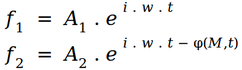 where ω is the pulsation of the waves and φ(M,t) is the phase shift between the two waves.
As the integration time is in general much larger than the waves period (the integration time is in the range of ~ 0,1 s for the eye and ~ 10-10 s for the fastest photodetectors while the wave period
where ω is the pulsation of the waves and φ(M,t) is the phase shift between the two waves.
As the integration time is in general much larger than the waves period (the integration time is in the range of ~ 0,1 s for the eye and ~ 10-10 s for the fastest photodetectors while the wave period 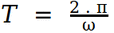 is in the range of 10-15 s) :
 where I1 and I2 are the intensities of the waves separately.
Therefore, If the two waves are not synchronized which is the case for instance if they are coming from two different sources,
where I1 and I2 are the intensities of the waves separately.
Therefore, If the two waves are not synchronized which is the case for instance if they are coming from two different sources,  and
and 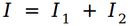 : no interference occur.
If the waves are coming from the same source and are synchronized as it is the case for the Young slit experiment mentionned above,
: no interference occur.
If the waves are coming from the same source and are synchronized as it is the case for the Young slit experiment mentionned above,  . The phase shift does'nt depend on time and interference occur. Indeed,
  where δ is the optical path difference between the two waves, λ is the wavelength and φ0 a constant phase shift which is equal to 0 or π depending on the types of the eventual reflexions experienced by the waves along the path (see next section and "polarization" tutorial).
In these conditions,
where δ is the optical path difference between the two waves, λ is the wavelength and φ0 a constant phase shift which is equal to 0 or π depending on the types of the eventual reflexions experienced by the waves along the path (see next section and "polarization" tutorial).
In these conditions,  . The intensity depends only on the position.
In short, if interference occur, the intensity is calcultated from the sum of amplitudes otherwise it is calculated from the sum of intensities.
In case of interference, the intensity is maximum when the waves are in phase (
. The intensity depends only on the position.
In short, if interference occur, the intensity is calcultated from the sum of amplitudes otherwise it is calculated from the sum of intensities.
In case of interference, the intensity is maximum when the waves are in phase ( - corresponding to constructive interference) and minimum when they are out of phase (
 - corresponding to destructive interference). Thus the pattern gernerally contains a succession of bright and dark zones which are the fringes defined above. The distance between two successive bright fringes or two successive dark fringes is called the interfringe.
The contrast is defined by
- corresponding to destructive interference). Thus the pattern gernerally contains a succession of bright and dark zones which are the fringes defined above. The distance between two successive bright fringes or two successive dark fringes is called the interfringe.
The contrast is defined by  where IMin and IMax are respectively the minimum and the maximum intensities of the interference pattern.
The contrast is maximum when the interfering waves have the same intensity.
As mentionned above, one condition for interference with linearly polarized waves is that the superimposed waves have close enough electric fields directions. This means also that the waves are propagating in close enough directions.
Interference may also happen with unpolarized synchronized waves. Indeed, if they are propagating in close directions, their amplitudes can be projected on two perpendicular directions and the situation is equivalent to the interference produced by two sets of synchronized and linearly polarized waves on two perpendicular directions.
The fact that the waves come from the same source is not sufficient to obtain interference. Indeed, waves are synchronized when the delay between them is smaller than a certain value called the coherence time and corresponding to the duration of a wave train emitted by a single atom of the source. The coherence length is the length of this wave train. It can be approximated by the following formula :
where IMin and IMax are respectively the minimum and the maximum intensities of the interference pattern.
The contrast is maximum when the interfering waves have the same intensity.
As mentionned above, one condition for interference with linearly polarized waves is that the superimposed waves have close enough electric fields directions. This means also that the waves are propagating in close enough directions.
Interference may also happen with unpolarized synchronized waves. Indeed, if they are propagating in close directions, their amplitudes can be projected on two perpendicular directions and the situation is equivalent to the interference produced by two sets of synchronized and linearly polarized waves on two perpendicular directions.
The fact that the waves come from the same source is not sufficient to obtain interference. Indeed, waves are synchronized when the delay between them is smaller than a certain value called the coherence time and corresponding to the duration of a wave train emitted by a single atom of the source. The coherence length is the length of this wave train. It can be approximated by the following formula : 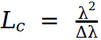 where λ is the central wavelength and Δλ is the spectral width of the source.
If
where λ is the central wavelength and Δλ is the spectral width of the source.
If  , interference may occur. On the other side, no interference can be observed if
 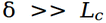 .
Finally, a source is generally not punctual (the collimated laser beam mentionned above can be considered as coming from a punctual source at infinity) but made of several punctual sources which are in general uncoherent with each other. Therefore, The intensity of the interference pattern is the sum of the intensities of interference produced by each punctual source. As the difference between the phase shifts from two different source points increases with their distance, the contrast may significantly decrease when the source size increases. The interference pattern may even disappear if the source is too large.
.
Finally, a source is generally not punctual (the collimated laser beam mentionned above can be considered as coming from a punctual source at infinity) but made of several punctual sources which are in general uncoherent with each other. Therefore, The intensity of the interference pattern is the sum of the intensities of interference produced by each punctual source. As the difference between the phase shifts from two different source points increases with their distance, the contrast may significantly decrease when the source size increases. The interference pattern may even disappear if the source is too large.