
Tutorial : secondary source - secondary source intensity vs received luminous flux - isotropic diffusion
Diffusion
The diffusion is a deflection of light in various directions as a result of interaction with matter.
It is caused by the granularity of the material when it is comparable to the wavelength of the incident wave.
Diffusion can be in transmission (rays diffused in the same sense as the incident beam ) or in reflexion (rays diffused in the opposite sense ).
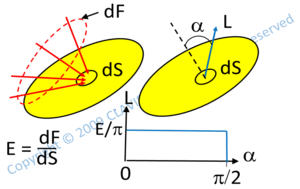 Diffusers that are diffusing uniformly on the whole half space are called Lambertian diffusers.
The radiance of a perfect lambertian diffuser illuminated with a given irradiance E is :
 .
.
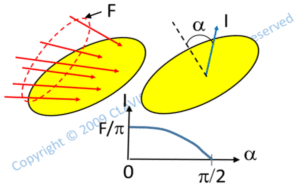 The intensity diffused by a lambertian diffuser illuminated with an optical power F in the direction making an angle α with the normal to the diffuser is :
 .
.
Diffusers may also scatter light inside a given cone, which means that a collimated incident beam at a given incidence angle is only diffused inside the cone. This cone can have for instance a circular basis or a rectangular basis.
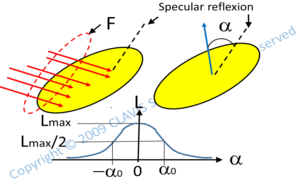 Some diffusers have a gaussian shaped radiance regarding the incident light direction ( diffuser in transmission ) or regarding the specular reflexion direction ( diffuser in reflexion ). The radiance in a direction making the angle α with the incident (or specular reflexion) direction is :
 .
.
Lmax is the maximum radiance and α0 is the angle corresponding to the directions for which the radiance is Lmax / 2.
Lmax can be calculated from the irradiance E on the diffuser :
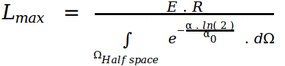 .
.
ΩHalf space is the solid angle corresponding to the half space delimited by the diffuser surface.
Integrating spheres
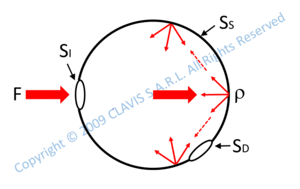 Integrating spheres are spherical diffusers coated with a lambertian diffusing paint.
They are used to measure the total power of light sources that is normally difficult to realize with sources emitting on wide angles.
They include an aperture through which the light injected (surface area SI). Alternatively, the light source can be put inside the integrating sphere . They contain also a detector (surface area Sd). In any case, the surface for the light injection (or the surface of the light source) and the detector surface are not diffusing.
Also, a baffle may be needed when the light source is inside the integrated sphere in order to protect the detector from direct illumination by the source.
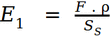
Because the light is uniformly diffused, the irradiance is the same anywhere in the sphere. After one reflexion its value is :
 .
.
ρ is the sphere reflectivity, SS the sphere area, F the luminous flux and  .
.
After N reflexions, its value is :
 .
.
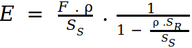
Therefore, the total irradiance on the sphere wall is uniform and its value is :
 .
.
Finally :
 .
.
The detected power is then :
.
According to the formula above, the injected power is proportionnal to the detected power and can be calculated from the reflectivity, the sphere area, the detector area and the eventual aperture area.