Tutorial : luminance
Photometric units
The human eye a a certain sensitivity to radiations.
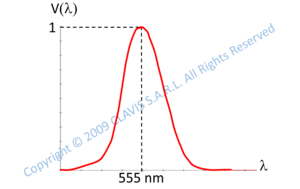 The visibility curve V ( λ ) represents the normalized sensitivity of the human eye to radiations depending on the wavelength for daytime vision. The curve is not flat. It has a bell shape with a maximum at 555 nm. This means that for instance, a flux at 555 nm is seen brighter than the same flux at 650 nm. Therefore, a higher flux at 650 nm is needed to be seen at the same brightness than at 555 nm.
V ( λ ) is calculated in the visible range ( from ~ 400 nm to ~ 800 nm).
Whatever the considered parameter, if Pr is the value in SI radiometric and Pp, its value in SI photometric unit, for a monochromatic radiation :
 .
.
K555 is a constant defined with the intensity.
It is the intensity in SI photometric unit ( which is the candela - abbreviation : Cd) corresponding to an intensity of 1 W/Sr at 555 nm. Therefore, K555 is expressed in Cd .Sr / W.
K555 = 683 Cd .Sr / W.
At any wavelength λ :
 .
.
The different photometric units and their corrsepondance in radiometric units for monochromatic radiations are therefore :
- Intensity : Cd (Candela) (  ),
),
- flux or power : lumen (  ),
),
- irradiance : lux (  ),
),
- emittance : lux (  ),
),
- luminance or radiance (in radiometry ) : Cd /m2 (  ).
).
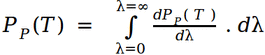
For polychromatic radiations, whatever the parameter P ( intensity, radiance or luminance, flux or power, irradiance, emittance) Pr can be expressed as follows :
 .
.
Therefore :
 .
.
For instance, it is possible to calculate the luminance of a balck body at a cetain temperature in Cd/m2 ( photometric unit ) , using the precedent formula.