
Tutorial : secondary source conjugated by an optical system - radiance of the secondary source
Radiometry basics
The radiometry is the field of photonics describing and quantifying the energy of light radiations. For instance, it may characterize the amount of light emitted by a source, received by a surface, transmitted through a medium or through an optical system....
When applied to the human vision, the radiometry is called photometry. The light energy is then considered as perceived by the human eye and is therefore expressed with dedicated units (photometric units - see "photometry section").
For example, 1 watt in the green-yellow at 555 nm ( maximum diurnal eye sensitivity ) is seen brighter than 1 Watt in the red at 650 nm. It is then useful to take into account this characteristic. The photometry is the part of photonic science describing and quantifying light energy as seen by the human eye.
The photometry uses its own units like the "lumen" which is a power unit depending on wavelength. The curve giving the ratio Lumen/Watt vs wavelength is homotetic to the diurnal sensitivity of the human eye. When normalized, this curve represents the luminous efficiency of the human eye at each wavelength for the diurnal vision. Lumen is said to be a "photometric" power unit. Derived parameters like intensity, radiance ( or luminance ), irradiance ( or illuminance), emittance can also be expressed in photometric units. Usually, the words luminance and illuminance are used in photometry and are expressed with photometric units while the words radiance and irradiance are used in radiometry and are expressed in radiometric units.
Photometric units are detailed in the "photometric units" section. Up to this section, only radiometry is discussed and therefore radiometric units are considered.
Basic parameters
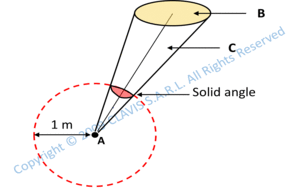 Among all the parameters used in radiometry, the most important is the "solid angle" representing an angle in three dimensions. Considering a cone C formed by a surface B viewed from a point A, the solid angle defined by C is the area of the surface defined as the intersection of C by the sphere centered on A and wich radius is 1 meter.
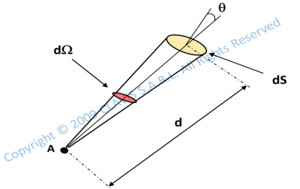 The element of solid angle corresponding to the cone formed by the surface element dS viewed from the point A is :
 .
.
d is the distance from A to the surface and θ is the angle between the normal to the surface and the direction of incidence.
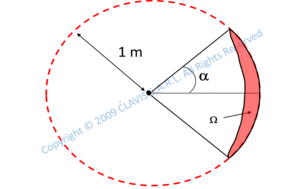 The solid angle corresponding a cone with a circular basis with a half angle α is :
 .
.
Therefore, the solid angle corresponding to the full space and half space are respectively 4 π and 2 π.
There are a some very useful parameters currently used in radiometry.
The flux F represents an optical power. It can be emitted by a light source, transmitted by an optical system, detected by a photodetector, etc. It is expressed in Watts.
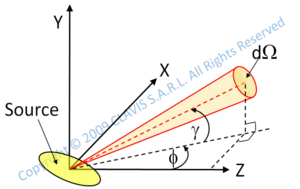 The intensity I of a light source represents the flux emitted in a given direction. It is the derivate of the flux by solid angle :
 .
It is expressed in W/sr.
.
It is expressed in W/sr.
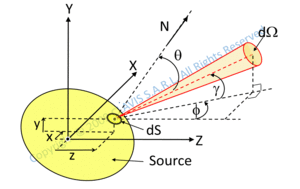 The radiance L of a light source is the intensity emitted per surface area. It is therefore the derivate of the intensity by surface area :
 .
.
 .
.
It is a local parameter expressed in W/sr/m2.
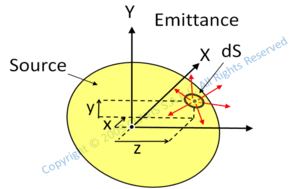 The emittance M of a light source is the total flux emitted per surface area. It is the derivative of the emitted flux by surface area of the source :
 .
.
 .
.
It is a local parameter expressed in W/m2.
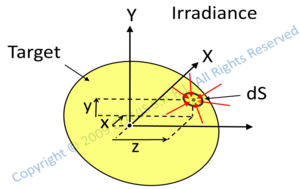 The illuminance or irradiance E is the flux received by surface area. It is the derivative of the received flux by surface area of the receiving surface. :
 .
.
It is a local parameter expressed in W/m2.
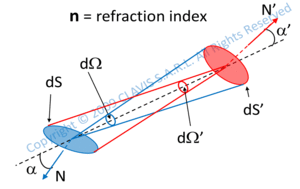 The etendue is a geometric parameter that characterizes the flux emitted by a source and received by a receiver.
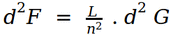
Let consider two surface elements dS and dS' which normals make respectively an angle teta and teta' with the segment connecting them, the etendue is the value d2G defined by the following relation :
The etendue is a geometric parameter that characterizes the flux emitted by a source and received by a receiver.
Let consider two surface elements dS and dS' which normals make respectively an angle teta and teta' with the segment connecting them, the etendue is the value d2G defined by the following relation :
 .
.
The etendue can also be defined as follows :
 .
.
Let consider dS as a source, the etendue characterizes a light brush emitted by dS and received by dS'. The flux emitted by dS and received by dS' is :
 .
.
L is the radiance of the source.
Reciprocally, if dS' ( radiance L') is as a source, the etendue characterizes a light brush emitted by dS' and received by dS. The flux emitted by dS' and received by dS is :
 .
.
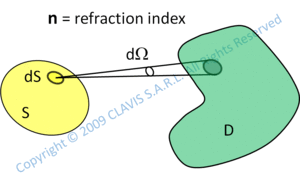 For a system made of a source S emitting through an aperture of diameter D, the etendue of the system is the sum of all the etendue elements defined by a source element dS and a solid angle element dΩ :
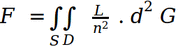 .
.
Radiometry and optical systems
Etendue conservation
Let consider a small light source of area dSo conjugated by a perfect optical system in Gauss conditions.
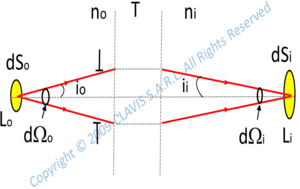 The etendue in the object space is :
 .
.
no is the refraction index in the object space, dΩo is the solid angle defined by the aperture angle io in the object space.
 .
.
The etendue in the image space is :
 .
.
no is the refraction index in the image space, dΩi is the solid angle defined by the aperture angle ii in the image space and dSi is the area of the source conjucgated.
 .
.
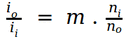
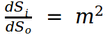
The paraxial formulas give the following relations :
 and
and
 .
.
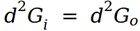
m is the magnification of the optical system. Therfore :
 .
.
The etendue is thus conserved through the optical system.
Considering the transmission T of the optical system and the flux in the object space d2Fo, the flux in the image space is :
 .
.
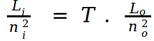
Therefore, as  , the radiance of the secondary source (conjugated of the initial source by the optical system) is :
 .
.
If the initial and final media have the same refractive index, the ratio between the radiance of the conjugated source and the radiance of the initial source is equal to the transmission.
Irradiance produced by a source and an optical system
The irradiance on a screen can be anaytically calculated in some cases where light go through a perfect optical system ( in Gauss conditions).
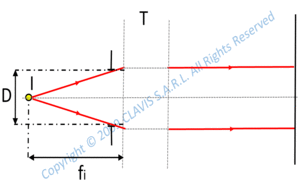 In the case where a punctual isotropic light source ( intensity I ) is in the focal plane of a system ( focal length fi ), the irradiance on a screen, whatever its position, is :
 .
.
D is the aperture diameter and T is the system transmission.
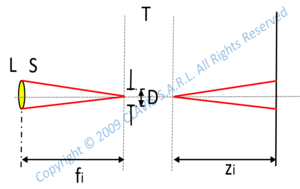 In the case of a small Lambertian source ( area S and radiance L ) located in the front focal plane of the slightly opened system, the beam is slightly diverging after being transmitted trough the optical system. Therefore, the irradiance depends on the position zi of the screen. Indeed, the flux after the system is :
 .
.
Considering the beam area Si on the screen :
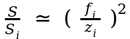 .
.
Therefore, the irradiance E on the screen is :
 .
.
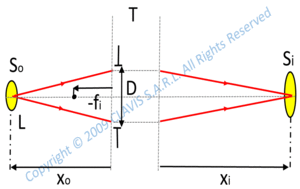 In the case where the screen is conjugated with a small Lambertian source ( area So and radiance L ) and considering that the system has a small aperture, the flux on the screen is :
 .
.
xo is the algebric distance of the source.
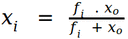 where
xi is the algebric distance of the source conjugate.
where
xi is the algebric distance of the source conjugate.
The magnification is given by :
 .
.
If Si is the area on the screen and m is the magnification :
 .
.
Then, the irradiance on the screen is :
 .
.
In the case where the light source is at infinity and the screen is located in the back focal plane of the system :
 .
.
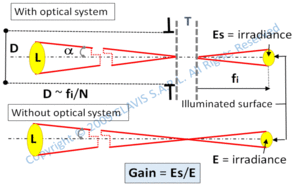 In this case, when defining the aperture with the aperture numbre N, the ratio between the irradiance on the screen with and without the optical system is ( the angular size α of the source is supposed to be small ) :
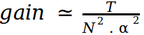 .
.