
Tutorial : isotropic source - circular aperture - light source with given intensity – given aperture diameter
Light sources
Isotropic sources
An isotropic source is a source which intensity I is constant whatever the direction. Therefore, its total flux is :
 .
.
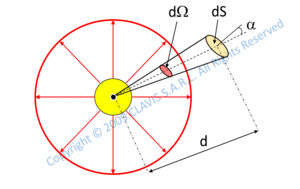 Let consider a punctual isotropic source, the flux received by a small surface area dS at a distance d is :
 .
α is the angle between the direction of incidence and the normal to the surface.
.
α is the angle between the direction of incidence and the normal to the surface.
The irradiance on the surface is :
 .
.
It varies in  (Bouguer law).
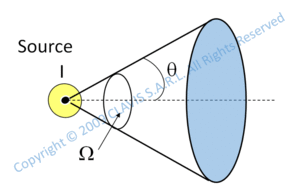 The flux emitted by a punctual isotropic source in a solid angle limited by a circle is :
 .
.
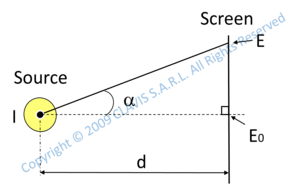 Let consider a screen at a distance d from the source. The irradiance at a location where the direction of incidence makes an angle α with the normal is :
 .
.
E0 is the irradiance for α = 0 :
 .
.
Lambertian sources
Lambertian sources have a constant radiance whatever the location on the source and whatever the considered direction of observation.
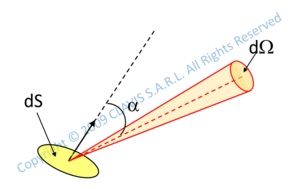 The flux emitted by a source element dS in a given direction α and a given solid angle element dΩ is :
 .
.
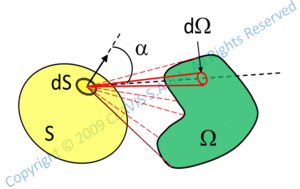 Therefore, the flux emitted by the full source S in a given aperture is Ω :
 .
.
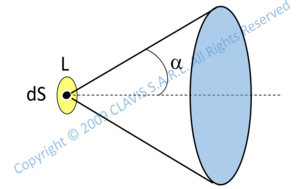 The flux emitted by a surface element in a cone making an angle α with the normal to the surface is :
 .
.
The total flux (in the half space correponding to a 2 π solid angle) emitted by the surface element is therefore :
 .
.
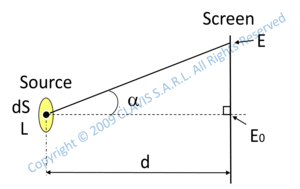 Let consider a screen at a distance d from the source. The irradiance at a location where the direction of incidence makes an angle α with the normal is :
 .
.
E0 is the irradiance for α = 0 :
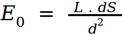 .
.
The intensity and flux of a lambertian source can be analytically calculated in some particular cases.
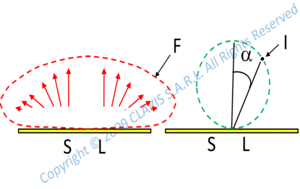 For a flat source which surface area is S, the total flux is :
 .
.
The intensity is :
 .
.
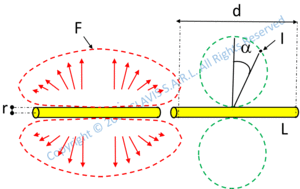 For a cylindrical source which length and radius are respectively r and d, the total flux is :
 .
.
The intensity in the direction α is :
 .
.
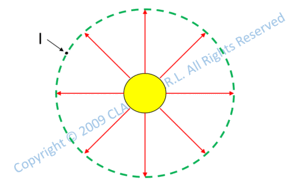 For a spherical source which radius is r;, the intensity is constant and its value is :
 .
.
The total flux is :
 .
.
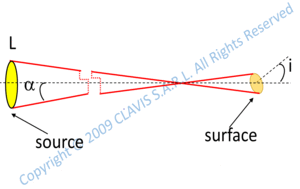 Let consider another case where the source is circular, Lambertian and located at infinity. Its size is defined by its angular radius α which is considered small. The irradiance on a surface with an inclination i is then :
 .
.