Tutorial : modal dispersion-step index fiber
Fiber optic basics
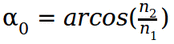
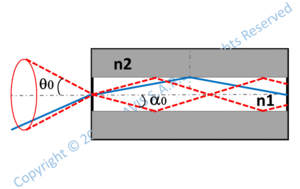 Fiber optics are cylindrical and flexible components guiding light. They are made of a cylindrical core surrounded by a concentric cladding. The refraction index of the core (n1) is larger than the refraction index of the cladding (n2) so that total reflexion can occure at the core/cladding interface. Indeed, total reflexion happens for rays propagating in the core and contained in the cone centered on the optical axis and which half angle is :
  .
.
Therefore, rays contained in this cone may be guided in the fiber optic.  is the numerical aperture and defines the acceptance angle
  .
.
θ0 is different from α0 because of the refraction at the fiber entrance (interface air/core). Note that the formula defining the numerical aperture is suitable for multimode fibers only, the numerical aperture for single mode fibers being defined with the half divergence angle of the gaussian beam with the fiber mode diameter wf (see section below).
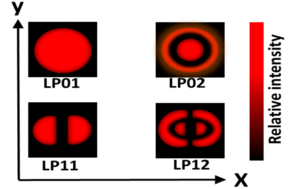 While Total reflexion is a basic and intuitive approach, it is nonetheless unsufficient to explain light wave guiding in fiber optics. To understand light propagation in fiber optics, it is necessary to consider light as an electromagnetic wave. Electromagnetic equations solved with adequate boundaries conditions at the core/cladding interface show that only some specific waves can propagate along the fiber. They are the fiber optic modes and are named LPmq modes. m corresponds the number of intensity minima along the azimuthal axis, while q is the number of intensity minima along the radial axis. Among all possible modes, one specific mode is called the fundamental mode (corresponding to LP01 mode) which is detailed further in this tutrorial. The graphic nearby illustrates schematically the relative intensity of a few low order modes.
One important parameter to charcacterize the fiber optic at a given wavelength is the normalized frequency :
 where R is the core radius and λ is the wavelength. V indicates if the fiber optic is single mode or multimode. Indeed, the fiber optic is single mode if
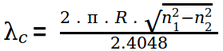
  and multimode otherwise. Single mode means that the fundamental mode only can propagate. Note that a fiber optic is not intrinsically single mode or mutimode. It is single mode for wavelengths above the cut-off wavelength λc and multimode for wavelengths below λc. λc is defined as follows :
  .
.
The normalized frequency V is also suitable to give an approximate value of the number of modes propagating in a highly multimode number :  .
.
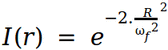
 The intensity distribution of the fundamental mode (LP01 mode which is the unique mode guided in a single mode fiber) is close to a gaussian shape :
  .
.
ωf which is the radius of the fundamental mode can be approximated with following formula :  .
.
ωf is slightly larger than the core diameter. It shows that the fundamental mode propagates mostly in the core but also in the cladding through evanescent waves.