Tutorial : resolution - MTF of a camera
imaging sensors
An imaging sensor is the photons sensing component of a camera and is made of a matrix of photodetectors called pixels. Depending on the spectral range, sensors are based on different technologies and materials. CMOS and CCD ( using Silicon) are common in the UV-VIS-NIR (Ultra Violet, Visible, Near-Infrared). InGaAs based sensors are widely used in the SWIR (Short Waves Infrared) and micro bolometers are very common for longer wavelengths in the infrared.
The quality of an imaging sensor is related to its sensitivity and its spatial resolution. The spatial resolution depends on the pixel size but also on the possible cross-talk between adjacent pixels as pixels are in general very close to each other.
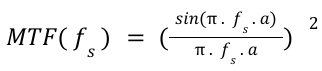
The spatial resolution of an ideal imaging sensor (without cross-talk) is limited by the pixel size and is given by the Modulation Transfer Function representing the contrast of the sensor depending on the spatial frequency (number of dark and brilliant lines per mm) of the target. For a target made of lines with a sinusoidal normalized intensity from 0 to 1 at a spatial frequency of fs, the maximum contrast obtained on a camera with a pixel size of a is: