Tutorial : noise - specific detectivity
Noise in photodetectors
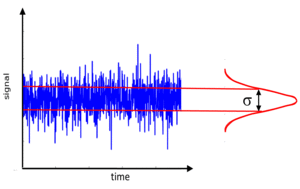 A photodetector provides a signal with small fluctuations. These fluctuations are the noise of the photodetector. The noise is randomatic and therefore can not be predicted.
It is given by the variance of the signal :
A photodetector provides a signal with small fluctuations. These fluctuations are the noise of the photodetector. The noise is randomatic and therefore can not be predicted.
It is given by the variance of the signal :
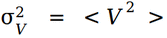 if the signal is a voltage or
 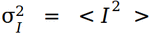 if it is a current.
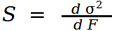
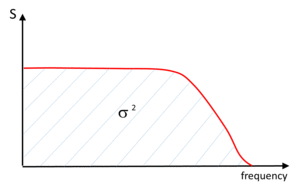 The noise depends on the fluctuations frequency. Therefore, it is more precisely caracterized by its spectral density corresponding to the derivative of the variance by the fluctuations frequency :
  .
.
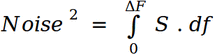
The total noise is limited to the photedector bandwidth ΔF. Thus, it is calculated with the integral of the spectral density on the bandwidth range :
 .
.
The obtained value is homogeneous to the squared signal and is thus the squared noise.
The noise can be lowered for example by limiting the bandwidth and thus cutting the high frequencies contribution.
Different noises
There are different sources of noise.
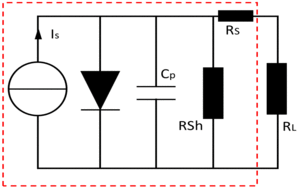 As detailed in the previous section, a semiconductor photodetector can be modellized by a theoretical current source connected to a perfect diode in parallel with a capacitor and a shunt resistance. It is depicted on the left-side scheme.
The first one is the shot noise. The shot noise is induced by the intrinsic quantic behaviour of light which is considered as a set of photons hitting the photodetector with randomatic time laps. The shot noise is defined by its spectral density which is :
 .
.
IS is the signal current (generated by light detection) and q is the electron charge.
The shot noise is the ultimate detection limitation. Indeed, it applies whatever the photedector (even it is noise free which is not realistic).
The shot noise applies not only to the signal but also to the dark current. The dark current ID is a leakage current induced by thermal agitation as detailed in the "quantic photodetectors" section. It has a randomatic flow and it creates a noise (dark current noise) similar to the shot noise induced by the signal and caracterized by the its spectral density :
 .
.
The shot noise applies also to the luminous background if any producing a current IB. Thus, the total shot noise is :
 .
.
The Johnson noise or thermal noise is the noise induced by the thermal agitation of the carriers in the shunt resistance and is caracterized by its spectral density :
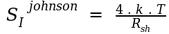 .
.
k is the Boltzman constant and T is the temperature (in Kelvin). Note that Johnson noise is also induced in the load resistance if any.
The Flicker noise is caused by slow fluctuations of the carriers in the semiconductor and is negligible for frequencies in the range of a few kHz. It is mainly induced by the photodetctor technology.
Noise Equivalent Power (NEP)
The Noise Equivalent Power (NEP) is defined as the optical power such that the signal to noise ratio is equal to 1 for a 1 Hz frequency bandwidth. It depends on the wavelength and is expressed in Watts per square roots of frequency.
Therefore, the associated signal current is :
 .
.
For a photodetector with a bandwidth ΔF, the optical power requested for achieving a signal to noise ratio of 1 is :
 .
.
At the wavelength λ, the NEP is:
 .
.
λpeak is the wavelength corresponding to the highest sensitivity.
Sometimes, the photodetectors manufacturers specify the specific detectivity :
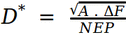 .
.
A is the area of the sensitive surface. As the NEP depends linearly on the square root of A, D* provides a normalized caracterization of the photodetor.
Signal To Noise Ratio (SNR)
The different noises (each caracterized by its current spectral density SIk ) are decorrelated from each other. The signal to noise ratio (SNR) is thus :
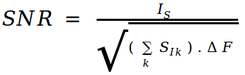 .
.
IS is the signal current.
When shot noise and Johnson noise are overriding :
 .
.
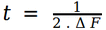 is the integration time.
In the case where the SNR is limited by the Shot noise (no Johnson noise) :
 .
.
The highest value of the SNR is obtained for a noise free detector including a null dark current. The SNR is then :
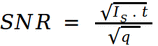 .
.
It is only limited by the shot noise of the signal. However, it is a theoretical case.
In the case where the NEP of the photodector is provided, SNR = 1 is achieved for an optical power equal to the NEP and an integration time of 0.5 s (corresponding to a frequency bandwidth of 1 Hz) :
 .
.
where Sdet is the spectral density of all intrinsic noises of the photodetector. Sdet is useful for any SNR estimation and can be calculated from the last formula :
 .
.
Case of Infrared detectors
For the IR detectors, the background noise comes from the radiations emitted by the surrounds. These radiations come for instance from the detector packaging, from the eventual optics and mounts, from the detector itself which therefore may request to be cooled...
Ideal thermal detectors ( BLIP : "Background Limited Infrared Photodetector") are considered to be limited by this background noise. Considering that the background flux is produced by a black body at a given temperature T and is viewed by the detector through a given angular field of view α, its value is :
 .
.
LB is the background radiance.
The noise equivalent power is therefore :
 .
.
The specific detectivity D* can be deducted from the NEP :
 .
.
D* depends on the quantum efficiency of the material, on the wavelength, on the field of view and on the temperature of the background (through the radiance - see "black body" tutorial).
Case of CMOS and CCD cameras
CMOS and CCD cameras are semiconductor based (Silicium) cameras. Each pixel is a photodetector. The principal noises that can be easily calculated are the shot noise, the dark current noise and the read out noise. The read out noise is created during the different read out steps of the pixel starting from the analog to digital conversion up to the image production. The read out noise is generally given as a number of electrons. It is independant from the integration time but is generated during each exposure. It means that if the image recording requests several exposures (for instance because the maximum exposure time is smaller than the integration time requested to obtain a suitable image), the total read out noise is the read out noise for one exposure multiplied by the square root of the exposure number m.
Therefore, considering that NpS is the number of photons per second of interest (providing the signal), NpB is the number of photons from the background, ND is the dark current expressed in e-/s and Ron is the read out noise expressed in e- :
 .
.