
Tutorial : numerical aperture – given aperture angle
Aperture
The aperture is supposed to be the only surface of the system stopping light rays. This surface can be in the object space, in the image space or in an intermediate space. In any case, it is possible to define the aperture in the object space: it is the conjugate of the aperture by the sub-system formed with the preceding components and used in the reverse way. Also, it is possible to define the aperture in the image space which is the conjugate of the aperture by the sub-system formed with the following components. The aperture in the object space enables to defines the solid angle inside which the rays are launched from the field(s). The aperture in the image space enables to eventually calculate the Wave Front Error and the associated parameters as well as the diffraction limit of the system. Note that in some cases, vignetting can appear. Indeed, some rays coming from off-xis objects may be stopped by another surface than the said aperture surface. This can affect the aberrations, limit the system resolution and create some shadows on the image. In general, one try to avoid vignetting and this case is not considered in the rest of the tutorial.
An optical system is represented in the pictures below with different aperture positions. Theoretically, the chief rays (chief rays are defined further in this tutorial) coming from different objects (fields) intersect the aperture surface at the same point. This point is the aperture center.
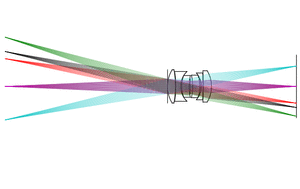
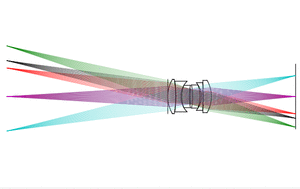 In the left picture, the aperture is defined by the first surface. In the right picture, the aperture is defined by a surface in the middle of the optical system.
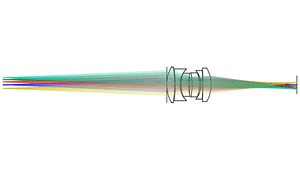
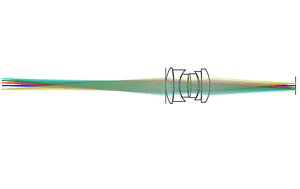 In the left picture, the system is telecentric (aperture at infinity) in the object space as the chief rays in the object space are all parallel. In the right picture, the system is telecentric in the image space as the chief rays in the image space are all parallel.
 The aperture can be defined in several ways.
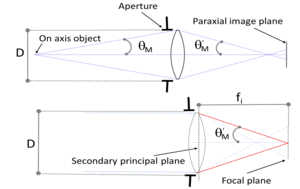
It can first be specified by the diameter D of the aperture itself.
It can also be defined by the half aperture angle θM in the object space. θM is the angle with the axis of a ray coming from the on-axis object and passing at the edge of the aperture in the object space (called marginal ray).
θM is often used to specify the aperture of illumination optics. For these systems, θM may be larger than 90°.
The aperture is commonly specified with the numerical aperture in the object space NA.
The aperture can be defined in several ways.
It can first be specified by the diameter D of the aperture itself.
It can also be defined by the half aperture angle θM in the object space. θM is the angle with the axis of a ray coming from the on-axis object and passing at the edge of the aperture in the object space (called marginal ray).
θM is often used to specify the aperture of illumination optics. For these systems, θM may be larger than 90°.
The aperture is commonly specified with the numerical aperture in the object space NA.
 where n is the refraction index in the object space.
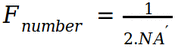
The aperture is also often defined with the F number (common notation: F/N, F#, Fnumber). It is currently the case for many systems as for instance camera lenses.
where n is the refraction index in the object space.
The aperture is also often defined with the F number (common notation: F/N, F#, Fnumber). It is currently the case for many systems as for instance camera lenses.
 .
.
 . is the numerical aperture in the image space (n' is the refraction index in the image space). The larger the aperture, the larger the numerical aperture and the lower the F number.
For optical systems with small aperture and working for objects located at infinity, the F number is approximately the ratio of the focal length fi to the diameter D of the stop surface :
. is the numerical aperture in the image space (n' is the refraction index in the image space). The larger the aperture, the larger the numerical aperture and the lower the F number.
For optical systems with small aperture and working for objects located at infinity, the F number is approximately the ratio of the focal length fi to the diameter D of the stop surface : 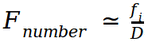 .
.