
Tutorial : image position and system parameters – given magnification - thin lens ( given distance between object and image)
Transverse magnification
For optical systems working in Gauss conditions, the paraxial image Pi of a plane P perpendicular to the optical axis
is also a plane perpendicular to the optical axis.
 Accordingly, for a segment joining two points A and B in the plane P,
the conjugated segment AiBi is contained in Pi and is perpendicular to the optical axis.
The transverse magnification m ( currently called "magnification" ) is the ratio AiBi/AB where AB and
AiBi are the algebric lengths of the considered segments. Consequently, m is an algebric value.
Accordingly, for a segment joining two points A and B in the plane P,
the conjugated segment AiBi is contained in Pi and is perpendicular to the optical axis.
The transverse magnification m ( currently called "magnification" ) is the ratio AiBi/AB where AB and
AiBi are the algebric lengths of the considered segments. Consequently, m is an algebric value.
m is constant whatever the points A and B in the plane P.
It is negative when AB and
AiBi have opposite signs (which means that object and image are oriented in opposite directions). It is positive when AB and
AiBi have the same sign ( which means that object and image are oriented in the same direction ).
m depends on the paraxial parameters of the optical system ( focal lengths, principal planes location ) and P position.
Conjugation formulas
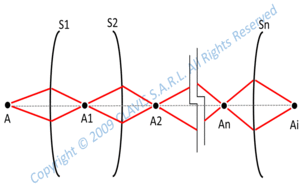 An optical system is in general made of several reflecting or refracting surfaces. The paraxial image of an object can be determined with a step by step process by calculating first the intermediate paraxial image of the object by the first surface, then calculating the conjugate of this intermediate image by the second surface and so on. This process is tedious. However, it is used for calculating the paraxial parameters detailed in the "paraxial parameters" tutorial as the principal planes, focal planes and focal lengths. Once these parameters determined, they are used in simple formulas to define the conjugation between an object and its paraxial image through the optical system.
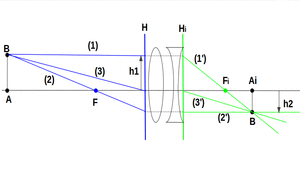 The position of the paraxial image through an optical system can be obtained geometrically considering two characteristic rays (ray (1) and ray (2)) coming from an off-axis object. The first ray (1) is parallel to the optical axis and the second one (2) goes through the front focal point. Both rays (1) and (2) intercept the primary principal plane at the respective heights h1 and h2 (h1 and h2 being respectively the object height and the image height). Therefore, emerging rays (1') and (2') respectively from rays (1) and (2) intercept the secondary principal plane at the same height than their incident ray on the primary principal plane. ray (1') focuses on the back focal point while ray (2') is parallel to the optical axis. The paraxial image of the object is the intersection of ray (1') and ray (2'). The plane passing through this point and perpendicular to the optical axis is the conjugated by the optical system of the plane perpendicular to the optical axis and passing through the object.
When the refraction indexes of the object and image spaces are the same, one can consider a third ray (3) coming from the object and intercepting the object nodal point (also front or primary nodal point). After passing through the optical system, the third ray (3') passes through the image nodal point (also back or secondary nodal point) and its direction is unchanged. Obviously, this third ray (3'), ray (1') and ray (2') are intersecting at the same point (corresponding to the paraxial image) of the object. In the general case where refraction indexes before and after the optical system are not the same, the direction (3') is not parallel to the direction (3).
According to the paragraph above, the position of the paraxial image plane is given by the position of its intersection Ai with the optical axis. A is the intersection of the object plane with the optical axis.
si is the algebric distance from the secondary nodal point Ni to Ai and can be calculated from the following formula :
 .
.
s is the algebric distance from the primary nodal point N to A,
f and fi are respectively the front and back effective focal lengths.
n0 and n1 are the refraction indexes respectively in the object and in the image space.
The magnification is 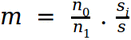 .
.
Note that in the case where the refraction indexes before and after the system are the same : 
In the case of a mirror where the emerging rays propagate against the incident rays direction,  .
.
 Ai position can also be calculated with xi the algebric distance from the vertex of the last optical
surface to Ai.
Ai position can also be calculated with xi the algebric distance from the vertex of the last optical
surface to Ai.
xi is then a function of x, f ( or fi ),
n0, n1, l and li where x is the algebric distance from the vertex of the first optical surface to A, l is the algebric distance from the vertex of the first optical surface to the primary nodal point N and li is the algebric distance from the vertex of the last optical surface to the secondary nodal point Ni.
Sometimes, it can be useful to calculate z and zi which are respectively the algebric distances
FA and FiAi (F and Fi being respectively the front and back focal points) : 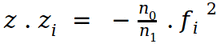 .
.