Tutorial : focal lengths - principal planes - combination of 2 thin lenses
Thin lens in the air
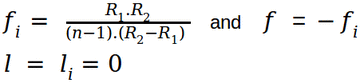
 A lens is considered as a a thin lens when its center thickness is small enough to be neglected. It is a theoretical case which is however very useful. Here, we consider the case where the lens is in air or vacuum. The vertexes of the lens surfaces coincide. They coincide also with the object and image nodal points. The paraxial parameters are given by the simplified formulas below (the general formula is detailed in the section "Thick lens in the air") :
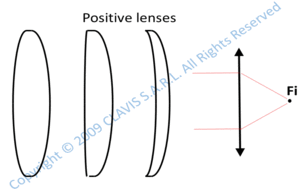
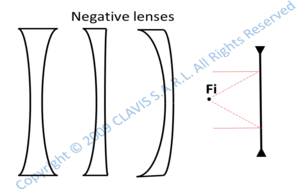 From the focal length formula, one can see that the lens type (positive or negative) can be easily deducted from its shape. Indeed, for instance, biconvex and plane-convex lenses are positive (fi positive) while biconcave and plane-concave lenses are negative (fi negative). A Lens with both convex and concave surfaces is positive if the radius of the convex surface is smaller than the radius of the concave one.
The image of a point at infinity through a positive lens is real, which means that the rays effectively intercept the image focal point while the image through a negative lens is virtual, which means that the rays never "physically" intercept the image focal point but only their directions do.
Focal lengths and other parameters
 Focal lengths are necessary parameters for calculating the paraxial image of a given object.
The front effective focal length f is the algebric distance NF from the front nodal point ( or primary principal point ) N to the front focal point F or from the primary principal plane H to the front focal plane Pf.
The back effective focal length fi is the algebric distance NiFi from the back nodal point ( or secondary principal point ) Ni to the back focal point Fi or from the secondary principal plane Hi to the back focal plane Pfi.
The optical system is said positive (or converging) in the case where the effective back focal length is positive with respect to the direction of the emerging rays. It its said negative (or diverging) otherwise.
Sometimes (particulary in ophtalmic optic), focal lengths are replaced by their inverse value which is commonly called the power.
As principal planes are generally not coinciding with a surface of the system, it is also useful to calculate the front and back focal lengths ft and fb.
ft is the algebric distance from the vertex of the first optical surface to the front focal point F.
fb is the algebric distance from the vertex of the last optical surface to the back focal point Fi.
The front and back focal lengths (not to be confused with front and back effective focal lengths) are not used for optical calculations but for positionning the focal planes regarding a mechanical reference.
Note that the definitions of the front and back focal lengths given above are not standard. For instance, some manufacturers selling mounted lenses may define the front and back focal lengths referred to the mount.
Some other characteristic lengths may be necessary to locate the principal planes referred to mechanical references. They are listed below :
l - distance from the vertex of the first optical surface to the primary principal point N ;
li - distance from the vertex of the last optical surface to the secondary principal point Ni ;
d - distance from the primary principal plane H to the secondary principal plane Hi .