Tutorial : photon to electron conversion - sensitivity of a photodetector
Photodetection basics
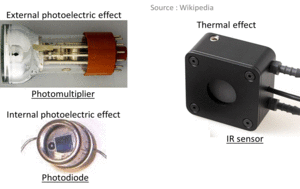 Photodetectors are optoelectronic components converting light into electrons.
There are three main phenomenom for photodetection : the external photoelectric effect, the internal photoelectric effect and the thermal effect.
Photodetectors are optoelectronic components converting light into electrons.
There are three main phenomenom for photodetection : the external photoelectric effect, the internal photoelectric effect and the thermal effect.
The photoelectric effect applies for detection in the ultra violet, visible and near infrared specral range while the thermal effect applies in the infrared region for wavelengths from around 3 microns up to 30 microns.
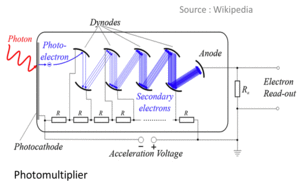 Basically, the external photoelectric effect occurs when a photon strikes a metal or semiconductor placed in vacuum. An electron is then emitted from its surface into vacuum.
Photomultipliers are based on this principle. The electron emitted from the cathode by the incident photon is then multiplied (hence the name) through a system of dynodes with progressive voltage (in the range of a few hundred Volts ) up to an anode. The incident photon energy has to be higher than a threshold depending on the photocatode material. Thus, photons corresponding to wavelengths above a given value can not generate electrons because their energy is not high enough.The final multiplication factor can be very high (in the range of 1 Million for 10 dynodes). Photomultipliers are therefore very sensitive to light and are used for application with low light levels.
In the case of internal photoelectric effect, the sensitive material is a semiconductor. When struck by a photon, an electron goes from the valence band to the conduction band thus creating a hole - electron pair. Then, either an electrical current is generated or the value of an electrical parameter is changed (for instance a resistance change can be induced). These detectors are commonly called quantic photodetectors.
Basically, the external photoelectric effect occurs when a photon strikes a metal or semiconductor placed in vacuum. An electron is then emitted from its surface into vacuum.
Photomultipliers are based on this principle. The electron emitted from the cathode by the incident photon is then multiplied (hence the name) through a system of dynodes with progressive voltage (in the range of a few hundred Volts ) up to an anode. The incident photon energy has to be higher than a threshold depending on the photocatode material. Thus, photons corresponding to wavelengths above a given value can not generate electrons because their energy is not high enough.The final multiplication factor can be very high (in the range of 1 Million for 10 dynodes). Photomultipliers are therefore very sensitive to light and are used for application with low light levels.
In the case of internal photoelectric effect, the sensitive material is a semiconductor. When struck by a photon, an electron goes from the valence band to the conduction band thus creating a hole - electron pair. Then, either an electrical current is generated or the value of an electrical parameter is changed (for instance a resistance change can be induced). These detectors are commonly called quantic photodetectors.
Thermal detectors detect temperature. Indeed, photons in the infrared range heat matter. Therefore, the temperature of a thermal detector increases when illuminated. One of its physical parameters is sensitive to temperature ( for example its electrical resistance ) and changes with temperature changes thus inducing a detection signal.
Quantic photodetectors
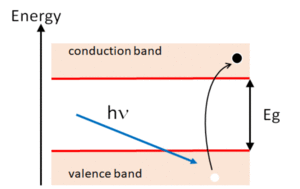 Quantic photodetectors include a semiconductor material. When illuminated, electrons in the valence band can absorb a photon and move to the conduction band. This requests that photons have a higher energy than the energy gap between the two bands.
There are two main types of quantic photodetctors.
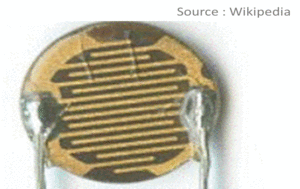 The photoresistance is made of a semiconductor material which resistance changes when illuminated. In the dark, most electrons are in the valence band and the resistance is high. When the illumination level increases, the conductivity increases (the resistance decreases) because more electrons are moving to the conduction band. The conductivity varies generally not linearly with the photon flux. Therefore this kind of detector is not used to detect a flux. It is for instance largely used to detect a threshold illumination level. The photosensisitive zone has a serpentine shape in order to maximize its length in a reduced area and therefore maximize its resistor sensitivity to light.
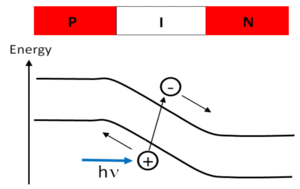 The photodiode is a PN junction. In the dark, its electrical characteristics is the one of a diode, which means that the current is null until the voltage exceeds a threshold value. Above this threshold value, the intensity increases very quickly (the resistance is then very low). When hit by a photon, an electron from the valence band in the junction area absorbs the photon and moves to the conduction band. It is then accelerated by the electrical field in the N doped region and create a current called photocurrent. The condition for the electron to absorb a photon is still that its energy E is at least equal to the band gap energy Eg :
  .
.
As  ( λ is the wavelength, c is the light velocity in air/vacuum and h is the Planck constant ), the condition on the wavelength is :
  .
.
A non null current exists even without any illumination. It is called the dark current. The dark current is induced by thermal effect. It increases both with the applied voltage and obviously with the temperature.
Let consider Np the number of photons per second hitting the photodetector :
 .
.
P is the optical power (expressed in Watts). The probability that an electron absorbs a photon is smaller than 1. Its called the quantum efficiency η. The number of electrons per second absorbing a photon is therefore :
 .
.
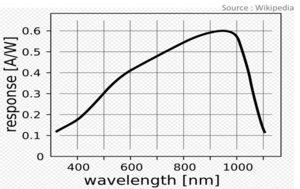 The photocurrent is :
  .
.
R( λ ) is the sensitivity of the photodetector and is expressed in A/W. From the precedent formula, the sensitivity increases linearly with the wavelength up to a value corresponding to the band gap energy. This can be justified by the fact that the larger the wavelength, the more photons are requested for the same power and thus the larger the current.
In reality, the quantic efficiency depends also on the wavelength and the sensitivity is therefore not linear regarding the wavelength as shown on the curve.
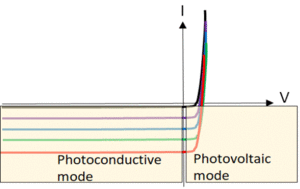 The two functionning modes of a photodiode are the photoconducting mode and the photovolotaic mode. As depicted on the curve, the photoconducting mode is when a reverse voltage is applied and the product of the voltage by the current is therefore positive. In this case, the current increases linearly with the luminous flux and is suitable for light detection. In the photovoltaic mode, the product voltage by current is negative and the device produces energy. It is for example the case of the pholvoltaic cells.
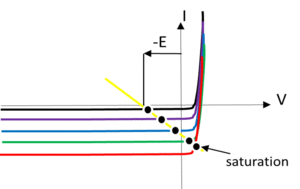 Because the dark current and thus its noise (see the "noise" section) increase with the applied voltage, low light level are preferably detected without any applied voltage. This regime is at the border between photovoltaic and photoconductor mode. Because the saturation level increases with the voltage, it is nonetheless preferable to apply a voltage when detecting high light levels.
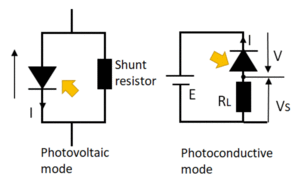 Ideally, the resistor of the photodiode is infinite. In reality, it is not. It is called the shunt resistor. The shunt resistor increases with temperature. The higher the shunt resistor the more the photodiode is sensitive to low light levels.
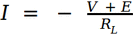
In photoconductor mode, the signal is detected through a resistor called the load resistor RL connected in series with the photodiode. The voltage Vs and current I across the load resistor are given by :
Ideally, the resistor of the photodiode is infinite. In reality, it is not. It is called the shunt resistor. The shunt resistor increases with temperature. The higher the shunt resistor the more the photodiode is sensitive to low light levels.
In photoconductor mode, the signal is detected through a resistor called the load resistor RL connected in series with the photodiode. The voltage Vs and current I across the load resistor are given by :
 ,
,
 .
.
V is the voltage across the photodiode and E is the applied voltage.
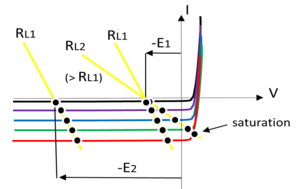 The larger the voltage applied or the lower the load resistor, the higher the saturation level.
The higher the load resistor, the higher the signal voltage and therefore the sensitivity to low signal levels.
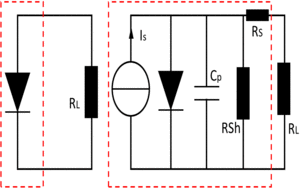 When used for detecting modulated light, a photodiode has a limited bandwidth.
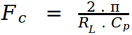
This limitation can be explained by adding to the photodiode scheme an equivalent capacity (internal capacity) Cp connected in parallel. The cut-off frequency is then :
When used for detecting modulated light, a photodiode has a limited bandwidth.
This limitation can be explained by adding to the photodiode scheme an equivalent capacity (internal capacity) Cp connected in parallel. The cut-off frequency is then :
 .
.
It is the frequency above which the signal contrast is smaller than 0,5 (3 dB attenuation) and defines the bandwidth of the photodiode.
The internal capacity decreases when the detector size decreases and when the applied voltage increases.
The bandwidth is not intrinsic to the photodiode as it depends not only on the internal capacity but also on the load resistor.
The higher the load resistor, the lower the bandwidth. Note that in the equivalent sheme, a series resistance (Rs) is also to be added.
Thermal photodetectors
There are three main types of thermal photodetectors : the thermopiles, the bolometers and the pytoelectric detectors.
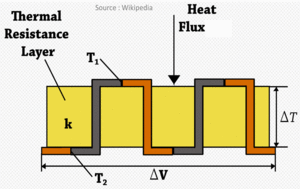 Thermopiles are made of thermocouples connected in series. A thermocouple is made of two different conductive materials that are soldered at one end. An absorbing layer is deposited on this junction and is heated when exposed to infrared radiations. Because of the temperature difference between the two ends of the conductive materials (one is heated and the other not), a voltage is created (Seebeck effect) which is proportionnal to the temperature difference and therefore to the heat radiation. Thermocouples don't request any bias voltage.
Bolometers use materials which resistivity depends on the temperature and therefore on the heat that has been absorbed. By applying a voltage across the resistor, any resistivity change is transformed in a current change depending on the variation of absorbed heat. These kind of thermal detectors are very sensitive. Among others, they are used in scientific and military applications.
Pyroelectric detectors use dielectric crystals (which are insulators) in which a temporary voltage appears when heated. This voltage is transient and disappears after a certain time called the dielectric relaxation time. Therefore, pyroelectric detectors can only detect modulated radiations. They can be used for instance to detect any intrusion or to measure the energy of a laser pulse.