
Tutorial : deviation
Prism deviation
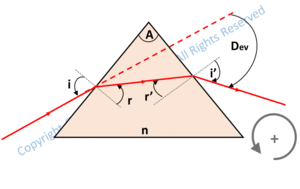 Lets consider that the prism is in the air or in vacuum and that light rays interact only with two facets of the prism making the angle A. Thanks to Snell-Descartes law, an incident ray is refracted by the first facet. As the prism refraction index is larger than 1, thanks to Snell-Descartes law again, the ray refracted by the first facet is not necessary refracted again by the second facet : a total reflexion may happen. The condition for the ray to be refracted by the second facet is :
 .
.
 .
.
It depends on the incidence angle i but also on the prism angle A and on the refraction index n.
If the ray is refracted by the second facet, its deviation regarding the incident ray is :  .
The different angles involved in the calculation of the deviation Dev are given by the following formulas :
.
The different angles involved in the calculation of the deviation Dev are given by the following formulas :
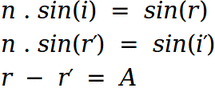 .
Note that with the signs conventions used in the schemes, the deviation Dev is negative.
The variation of deviation regarding the angle of incidence is :
.
Note that with the signs conventions used in the schemes, the deviation Dev is negative.
The variation of deviation regarding the angle of incidence is :
 .
.
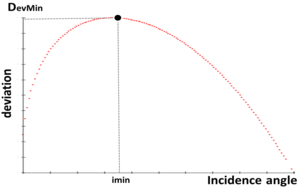
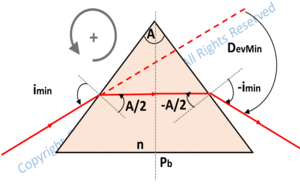 The absolute value of the deviation reaches a minimum (its algebric value reaches a maximum with the signs conventions adopted on this page - left side curve) when
 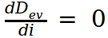 which is obtained for the incidence angle
  .
For the minimum deviation |DevMin|, the ray path is symmetrical with respect to the bissector plane Pb of the prism as illustrated in the right side picture.
.
For the minimum deviation |DevMin|, the ray path is symmetrical with respect to the bissector plane Pb of the prism as illustrated in the right side picture.
It is possible to calculate the refraction index as a function of A and |DevMin| :
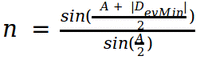 .
Therefore, one can deduct the refraction index of a prism when using it at the minimum deviation angle.
For a given angle of incidence and a given prism angle, the deviation variation versus the refraction index variation is :
.
Therefore, one can deduct the refraction index of a prism when using it at the minimum deviation angle.
For a given angle of incidence and a given prism angle, the deviation variation versus the refraction index variation is :
 .
It is related to the dispersion of the prism and therefore the power of the prism to spatially spread wavelengths. The formula shows that the absolute value of the deviation increases with the refraction index n .
Also, for a given angle of incidence and a given refraction index, the deviation variation versus the prism angle variation is :
.
It is related to the dispersion of the prism and therefore the power of the prism to spatially spread wavelengths. The formula shows that the absolute value of the deviation increases with the refraction index n .
Also, for a given angle of incidence and a given refraction index, the deviation variation versus the prism angle variation is :  .
Therefore, the absolute value of the deviation increases also with the prism angle A.
.
Therefore, the absolute value of the deviation increases also with the prism angle A.