Tutorial : time bandwidth product - pulse width estimation - mode locked laser
Different laser regimes
Lasers may have different regimes.
They can emit continuous waves (CW) such that the emitted power is constant. In this case, the pumping power is also constant.
They can be modulated. That is the case for laser diodes used for instance in optical communication. The modulated current enables then a modulated optical power.
Q-switching
Q-switching is a common mode for pulsed lasers. The cavity includes a Q-switch which is a component working schematically as an opened or closed gate. When the gate is closed, it introduces losses becoming then larger than the gain, therefore the population inversion can not occur and the laser wave can not propagate. However, the pump is still working so that the gain medium can store energy. When the gate suddenly opens, the losses become much lower than the gain and a powerful laser pulse is emitted. Among others, the energy per pulse depends on the pumping energy, on the gain medium, on the cavity, on the repetition rate and on the wavelength. The Q_switch can be an electromechanical device with an optical component enabling the cavity to be either aligned (opened gate) or misaligned (closed gate). Nowadays, acousto optics are mostly used as Q-switchs. Electro optics modulators requersting high voltage are also used for some low repetition rate and high power lasers.
Gain-switching
Gain-switching may be used for short pulse generation for instance in laser diodes. With a sufficient delay between the population inversion and the stimulated emission, the gain medium has time to store energy before emitting a short pulse. The pulse duration can be in the range of several tens of pico seconds for a laser diode.
Mode locking
Mode locked lasers are used to emit short pulses ( in the picoseconds or femtoseconds range ). In this case, the gain medium is able to amplify on a large spectral band. Thanks to a mode locker, longitudinal modes ( which can be numerous because of the large gain band ) can only oscillate at about the same time. When all the modes are synchronized, the minimum pulse duration is achieved and the time-bandwidth product is constant.
The pulse duration can be calculated from the time-bandwidth product as follows :
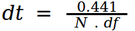 for a gaussian shape pulse and
 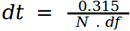 for a sech2 shape pulse.
dt is the pulse duration defined at Full Half Width Maximum (FWHM), df is the distance between two consecutive longitudinal modes expressed in the frequency space and N is the number of modes. Thus, the larger the emitted spectrum, the shorter the pulse.
The mode-locker can be for example a semiconductor saturable absorber mirror (SESAM) in the case of passive mode locking or an acousto optic or electro optic in the case of active mode-locking.
for a sech2 shape pulse.
dt is the pulse duration defined at Full Half Width Maximum (FWHM), df is the distance between two consecutive longitudinal modes expressed in the frequency space and N is the number of modes. Thus, the larger the emitted spectrum, the shorter the pulse.
The mode-locker can be for example a semiconductor saturable absorber mirror (SESAM) in the case of passive mode locking or an acousto optic or electro optic in the case of active mode-locking.