Tutorial : refraction by a plane surface
Refraction and reflexion laws
Refraction and Reflexion are both driven by the Snell-Descartes law :
 .
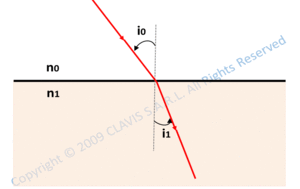
i0 is the incidence angle, i1 is the emergence angle, n0 and n1 are respectively the refraction indexes of the "incident" medium and of the "emerging" medium, the incident medium being the medium in which the incident ray is propagating and the emerging medium being the medium in which the emerging ray is propagating.
In case of refraction (left side scheme below), n0 and n1 are the refraction indexes respectively of the first and second media.
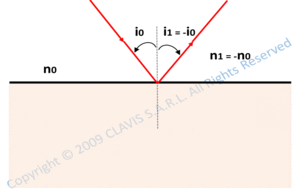
In case of reflexion (middle scheme below), n0 is the refraction index of the first medium and n1 = -n0. In consequence, the emergence angle i1 is opposite to the incidence angle i0 :
.
i0 is the incidence angle, i1 is the emergence angle, n0 and n1 are respectively the refraction indexes of the "incident" medium and of the "emerging" medium, the incident medium being the medium in which the incident ray is propagating and the emerging medium being the medium in which the emerging ray is propagating.
In case of refraction (left side scheme below), n0 and n1 are the refraction indexes respectively of the first and second media.
In case of reflexion (middle scheme below), n0 is the refraction index of the first medium and n1 = -n0. In consequence, the emergence angle i1 is opposite to the incidence angle i0 : 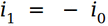 .
Considering two refringent media, according to the Snell-Descartes law, refraction is always possible when
.
Considering two refringent media, according to the Snell-Descartes law, refraction is always possible when  but is never possible when
  and
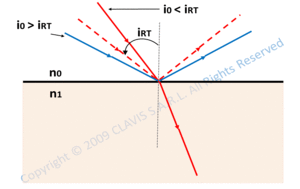
and 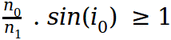 . In this case, total reflexion occure (no light is refracted).
 is the minimum incidence angle above which total reflexion happens (right side scheme below).
In general, if the total reflection conditions are not respected, both refraction and reflection happen. The amount of reflected and refracted light depend on the refraction indexes, on the incidence angle and on the light polarization. This aspect is treated in the "polarization" tutorial. Obviously, when the second medium is not refringent, refraction never occure.