Tutorial : longitudinal mode - gap between consecutive modes
Laser cavity
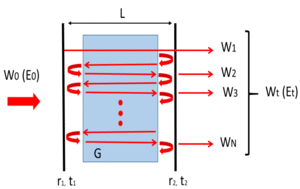 In the simplest configuration, the resonant cavity is a Fabry Perot made of two mirrors (see "Fabry Pertot" tutorial). At least, one mirror is not completely reflective. Therefore, it can transmit part of a light wave travelling inside the cavity and works as what is called the output coupler. Lets consider an incident light wave W0 (amplitude E0)on the Fabry Perot. It is amplified by the gain medium and partly reflected back and forth by the mirrors. Like in a Fabry perot interferometer, the output wave Wt (amplitude E0) is the combination of the wave W1 directly transmitted by the output coupler, the wave W2 transmitted after one round trip, the wave W3 transmitted after two round trips, ..., the wave Wn transmitted after n round trips, etc.
The transmission in amplitude is :
 .
.
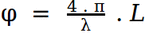 is the phase shift after one round trip and r1, t1, r2, t2 are the reflection and transmission coefficients in amplitude respectively of the first and second mirrors.
Unlike Fabry Perot interferometers, there is no incident wave in a laser cavity : the wave is generated inside the gain medium. Therefore, the laser emission can only happen if :
(1)
is the phase shift after one round trip and r1, t1, r2, t2 are the reflection and transmission coefficients in amplitude respectively of the first and second mirrors.
Unlike Fabry Perot interferometers, there is no incident wave in a laser cavity : the wave is generated inside the gain medium. Therefore, the laser emission can only happen if :
(1)  .
The imaginary part of the expression above must be null, therefore
.
The imaginary part of the expression above must be null, therefore  which means that the wavelengths λk (longitudinal modes) emitted by the laser are modes of the Fabry Perot :
 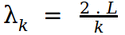 .
The corresponding frequency is
.
The corresponding frequency is  . Therefore, the distance between two consecutive longitudinal modes in the frequency space is :
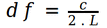 . It is constant.
Equation (1) can be written
. It is constant.
Equation (1) can be written  . When squared, this equality gives :
 .
Thus, not only the phase but also the intensity remains the same after one round trip in the cavity. In other words, the amplification by the gain medium after one round trip compensates the losses by the mirrors.
The last condition for a wave to be emitted by a laser is that its spatial intensity distribution remains the same after one round trip in the cavity otherwise no interference can happen. This means that the cavity is stable. The condition for a stable cavity is :
.
Thus, not only the phase but also the intensity remains the same after one round trip in the cavity. In other words, the amplification by the gain medium after one round trip compensates the losses by the mirrors.
The last condition for a wave to be emitted by a laser is that its spatial intensity distribution remains the same after one round trip in the cavity otherwise no interference can happen. This means that the cavity is stable. The condition for a stable cavity is :
 where
where  . L is the optical distance between the mirrors, R1 and R2 are the radii of the mirrors.
There are many different types of cavities. For simplicity, only two mirrors cavities have been considered but more complicated cavities like for instance ring cavities or Z shape cavities can be used.
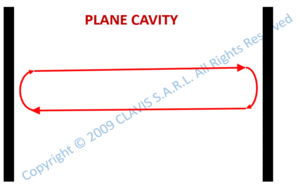
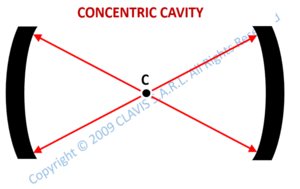
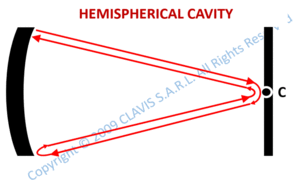
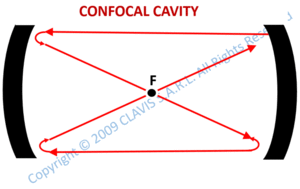
The most common ones using two mirrors are presented in the schemes below. Note that for plane and concentic cavities, L is the distance between the mirrors while its twice the distance for confocal and hemispherical cavities.
. L is the optical distance between the mirrors, R1 and R2 are the radii of the mirrors.
There are many different types of cavities. For simplicity, only two mirrors cavities have been considered but more complicated cavities like for instance ring cavities or Z shape cavities can be used.
The most common ones using two mirrors are presented in the schemes below. Note that for plane and concentic cavities, L is the distance between the mirrors while its twice the distance for confocal and hemispherical cavities.
 The laser spectrum depends not only on the resonant cavity but also on the gain medium. Indeed, The gain is not uniform depending on the wavelength and enables the population inversion only on a limited spectrum. Finally, one or a few longitudinal modes are generally emitted as shown on the left picture (the spectrum is represented in the frequencies space and df is the distance between two consecutive modes). It is possible also to select only one longitudinal mode in order to emit a very coherent light. Depending on the technology, single longitudinal mode lasers can for instance have a coherence length of several kms.