
Tutorial : total reflection by a plane refracting surface
Refraction and reflexion laws
Refraction and Reflexion are both driven by the Snell-Descartes law :
 .
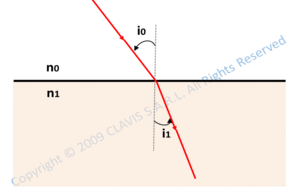
i0 is the incidence angle, i1 is the emergence angle, n0 and n1 are respectively the refraction indexes of the "incident" medium and of the "emerging" medium, the incident medium being the medium in which the incident ray is propagating and the emerging medium being the medium in which the emerging ray is propagating.
In case of refraction (left side scheme below), n0 and n1 are the refraction indexes respectively of the first and second media.
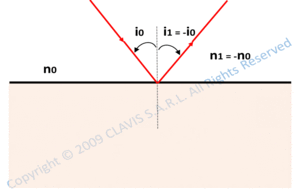
In case of reflexion (middle scheme below), n0 is the refraction index of the first medium and n1 = -n0. In consequence, the emergence angle i1 is opposite to the incidence angle i0 :
.
i0 is the incidence angle, i1 is the emergence angle, n0 and n1 are respectively the refraction indexes of the "incident" medium and of the "emerging" medium, the incident medium being the medium in which the incident ray is propagating and the emerging medium being the medium in which the emerging ray is propagating.
In case of refraction (left side scheme below), n0 and n1 are the refraction indexes respectively of the first and second media.
In case of reflexion (middle scheme below), n0 is the refraction index of the first medium and n1 = -n0. In consequence, the emergence angle i1 is opposite to the incidence angle i0 : 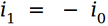 .
Considering two refringent media, according to the Snell-Descartes law, refraction is always possible when
.
Considering two refringent media, according to the Snell-Descartes law, refraction is always possible when  but is never possible when
  and
and 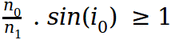 . In this case, total reflexion occure (no light is refracted).
 is the minimum incidence angle above which total reflexion happens (right side scheme below).
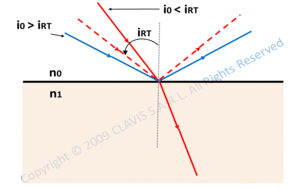
In general, if the total reflection conditions are not respected, both refraction and reflection happen. The amount of reflected and refracted light depend on the refraction indexes, on the incidence angle and on the light polarization. This aspect is treated in the "polarization" tutorial. Obviously, when the second medium is not refringent, refraction never occure.
Polarization and dielectric interfaces
The Snell descartes Law describes the reflexion and transmission of a light ray at the interface between two homogeneous media. This law applies also for waves.
The incident wave can be split in two waves : one wave with the electic field perpendicular to the incidence plane (defined as TE polarization - see "glossary") and the second one with the electric field in the incident plane (defined as TM polarization - see "glossary").
In this section, the magnetic field H is used instead of the magnetic induction B. They have the same direction and their amplitudes are linked by the relation :
 .
In the following formulas :
- index I is related to the parameters of the incident wave,
- index R is related to the parameters of the reflected wave,
- index T is related to the parameters of the refracted ( transmitted ) wave.
Wirh the same logic, nI and nT are the refraction indexes respectively of the first and second media.
.
In the following formulas :
- index I is related to the parameters of the incident wave,
- index R is related to the parameters of the reflected wave,
- index T is related to the parameters of the refracted ( transmitted ) wave.
Wirh the same logic, nI and nT are the refraction indexes respectively of the first and second media.
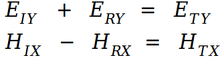
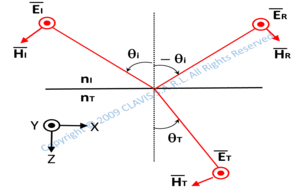 For TE polarization, the boundary conditions at the interface are :
 .
.
This brings to :
 .
Therefore, the reflexion and transmission ratios in amplitude at the interface are :
.
Therefore, the reflexion and transmission ratios in amplitude at the interface are :
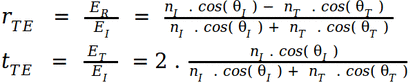 .
.
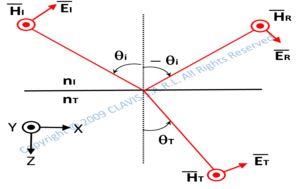 For TM polarization, the boundary conditions at the interface are :
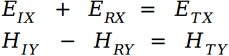 .
.
This brings to :
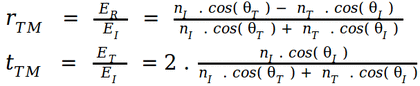 .
Whatever the polarization, if r ant t are respectively the reflexion and transmission ratio in amplitude, the reflexion and transmission ratios ( respectively R and T ) are given by :
.
Whatever the polarization, if r ant t are respectively the reflexion and transmission ratio in amplitude, the reflexion and transmission ratios ( respectively R and T ) are given by :
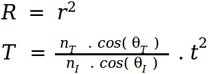 .
.
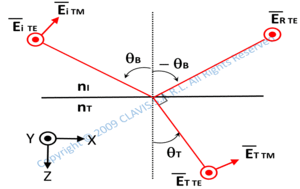 The reflexion coefficient is never null whatever the incidence angle for TE polarization. It can be zero for TM polarization for an incidence angle said Brewster angle θB satisfying :
  .
.
Incidence at Brewter angle is currently used to control the polarization. Indeed, the reflected light from an incident wave at Brewter angle is linearly polarized with an electric field perpendicular to the incidence plane (TE polarization). It is also commonly used in gas lasers. Indeed, the gas tube is closed by windows at Brewter angle. Therefore, the wave travels in the laser cavity without Fresnel reflexions at the windows interface for the TM polarization that can then oscillate more efficiently than TE polarization.