
Tutorial : lambertian circular source – cylindrical light guide
Light sources
Isotropic sources
An isotropic source is a source which intensity I is constant whatever the direction. Therefore, its total flux is :
 .
.
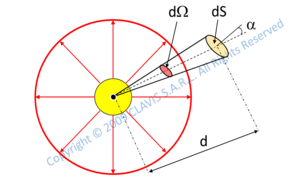 Let consider a punctual isotropic source, the flux received by a small surface area dS at a distance d is :
 .
α is the angle between the direction of incidence and the normal to the surface.
.
α is the angle between the direction of incidence and the normal to the surface.
The irradiance on the surface is :
 .
.
It varies in  (Bouguer law).
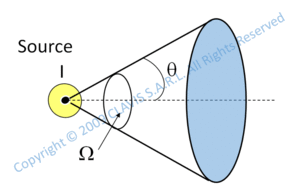 The flux emitted by a punctual isotropic source in a solid angle limited by a circle is :
 .
.
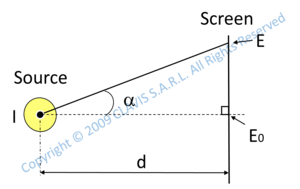 Let consider a screen at a distance d from the source. The irradiance at a location where the direction of incidence makes an angle α with the normal is :
 .
.
E0 is the irradiance for α = 0 :
 .
.
Lambertian sources
Lambertian sources have a constant radiance whatever the location on the source and whatever the considered direction of observation.
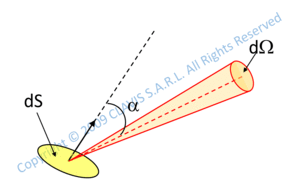 The flux emitted by a source element dS in a given direction α and a given solid angle element dΩ is :
 .
.
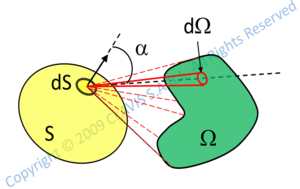 Therefore, the flux emitted by the full source S in a given aperture is Ω :
 .
.
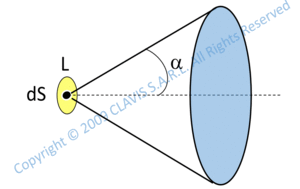 The flux emitted by a surface element in a cone making an angle α with the normal to the surface is :
 .
.
The total flux (in the half space correponding to a 2 π solid angle) emitted by the surface element is therefore :
 .
.
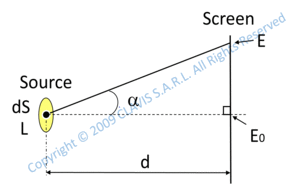 Let consider a screen at a distance d from the source. The irradiance at a location where the direction of incidence makes an angle α with the normal is :
 .
.
E0 is the irradiance for α = 0 :
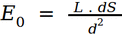 .
.
The intensity and flux of a lambertian source can be analytically calculated in some particular cases.
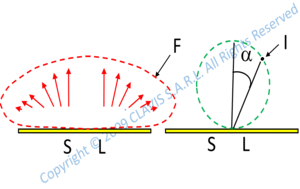 For a flat source which surface area is S, the total flux is :
 .
.
The intensity is :
 .
.
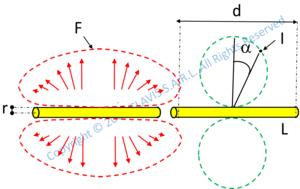 For a cylindrical source which length and radius are respectively r and d, the total flux is :
 .
.
The intensity in the direction α is :
 .
.
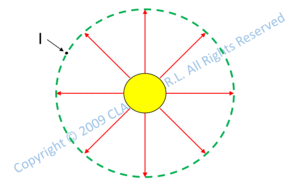 For a spherical source which radius is r;, the intensity is constant and its value is :
 .
.
The total flux is :
 .
.
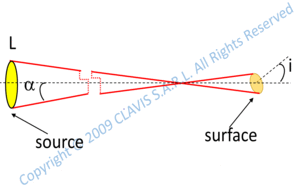 Let consider another case where the source is circular, Lambertian and located at infinity. Its size is defined by its angular radius α which is considered small. The irradiance on a surface with an inclination i is then :
 .
.
Radiometry and optical systems
Etendue conservation
Let consider a small light source of area dSo conjugated by a perfect optical system in Gauss conditions.
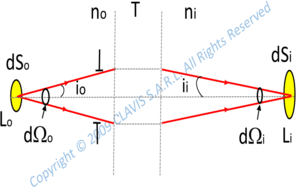 The etendue in the object space is :
 .
.
no is the refraction index in the object space, dΩo is the solid angle defined by the aperture angle io in the object space.
 .
.
The etendue in the image space is :
 .
.
no is the refraction index in the image space, dΩi is the solid angle defined by the aperture angle ii in the image space and dSi is the area of the source conjucgated.
 .
.
The paraxial formulas give the following relations :
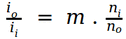 and
and
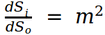 .
.
m is the magnification of the optical system. Therfore :
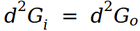 .
.
The etendue is thus conserved through the optical system.
Considering the transmission T of the optical system and the flux in the object space d2Fo, the flux in the image space is :
 .
.
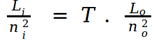
Therefore, as  , the radiance of the secondary source (conjugated of the initial source by the optical system) is :
 .
.
If the initial and final media have the same refractive index, the ratio between the radiance of the conjugated source and the radiance of the initial source is equal to the transmission.
Irradiance produced by a source and an optical system
The irradiance on a screen can be anaytically calculated in some cases where light go through a perfect optical system ( in Gauss conditions).
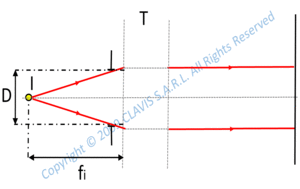 In the case where a punctual isotropic light source ( intensity I ) is in the focal plane of a system ( focal length fi ), the irradiance on a screen, whatever its position, is :
 .
.
D is the aperture diameter and T is the system transmission.
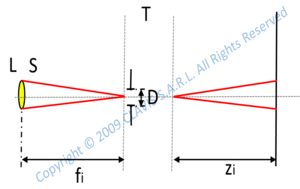 In the case of a small Lambertian source ( area S and radiance L ) located in the front focal plane of the slightly opened system, the beam is slightly diverging after being transmitted trough the optical system. Therefore, the irradiance depends on the position zi of the screen. Indeed, the flux after the system is :
 .
.
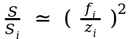
Considering the beam area Si on the screen :
 .
.
Therefore, the irradiance E on the screen is :
 .
.
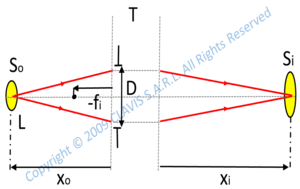 In the case where the screen is conjugated with a small Lambertian source ( area So and radiance L ) and considering that the system has a small aperture, the flux on the screen is :
 .
.
xo is the algebric distance of the source.
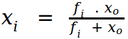 where
xi is the algebric distance of the source conjugate.
where
xi is the algebric distance of the source conjugate.
The magnification is given by :
 .
.
If Si is the area on the screen and m is the magnification :
 .
.
Then, the irradiance on the screen is :
 .
.
In the case where the light source is at infinity and the screen is located in the back focal plane of the system :
 .
.
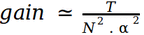
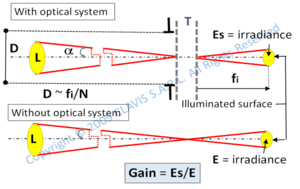 In this case, when defining the aperture with the aperture numbre N, the ratio between the irradiance on the screen with and without the optical system is ( the angular size α of the source is supposed to be small ) :
 .
.