
Tutorial : miscellaneous - plane parrallel plate - ray shift vs angle of incidence
Ray shift induced by a plane parallel plate
 Rays refracted through a plane parallel plate are not deviated but only translated. The longitudinal shift of a ray is:
 .
.
i is the incidence angle, n is the refraction index and e is the thickness. The transversal shift is then :
 .
.
The shift in a plane perpendicular to the ray is :
 .
.
Therefore, all incident rays focused at a point A are shifted to the front after transmission through the plate at a distance dx from A depending only on the incidence angle i. This means that the plate generates spherical aberration ( see "spherical aberration" tutorial ).
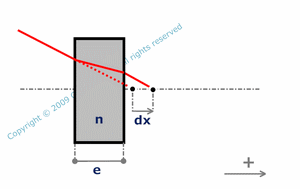 For sufficiently small incidence angles ( in Gauss conditions ), the longitudinal shift dx calculated above can be approximated as follows :
 .
.
dx is no more depending on the incidence angle. Therefore, the conjugate of a point by a plane parallel plate is a point shifted by dx. Note that the magnification is +1.