
Tutorial : wavelength to wave number
Spectrum
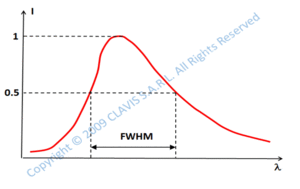 The spectrum of a light source defines the relative "quantity" of light emitted per wavelength (or per frequency). It is illustrated by a curve giving the relative intensity
(ordinate) emitted per wavelength or frequency (abscissa). The spectrum can be continuous as for thermal sources (like grey bodies) or discrete as for multimode lasers or luminescent sources. An important parameter defining the spectrum is the spectral width. Several definitions are used to specify the spectral width. It is often given by the
Full Width at Half maximum (FWHM) which is the distance on the abscissa between the wavelengths (or frequencies) with a relative intensity equal to half of the maximum value.
The spectrum of a light source defines the relative "quantity" of light emitted per wavelength (or per frequency). It is illustrated by a curve giving the relative intensity
(ordinate) emitted per wavelength or frequency (abscissa). The spectrum can be continuous as for thermal sources (like grey bodies) or discrete as for multimode lasers or luminescent sources. An important parameter defining the spectrum is the spectral width. Several definitions are used to specify the spectral width. It is often given by the
Full Width at Half maximum (FWHM) which is the distance on the abscissa between the wavelengths (or frequencies) with a relative intensity equal to half of the maximum value.
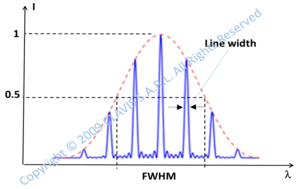 For luminescent sources or multimode lasers, there is a distinction between the spectral width and what is generally called the linewidth. The linewidth is the spectral width of a single mode emitted by a laser or of a single emission line of a luminescent source. More generally, the linewidth is used to define the spectral width of a light source with a narrow spectrum.
Any small spectral width or spectral shift can be converted from wavelength units to frequency units and vice versa according to the following formula:
 .
c is the light velocity in air or vacuum, λ is the wavelength and ν is the corresponding frequency.
The notion of spectrum is not only related to the light sources. Indeed, it can define the set of wavelengths that can be detected by a photodetector or transmitted by an optical system or component, etc.
An important phenomenom that can impact the spectral width is the Doppler-Fizeau effect. This phenomenom makes the frequency or wavelength received by a detector depend on the relative speed between the emitter and the detector. This phenomenom occurs on any wave type including electromagnetic waves and therefore light waves. This is for instance the major cause of linewidth enlargement of gaseous luminescent sources like for instance sodium sources. For electromagnetic waves, the shift between the frequency received by a detector (in the detector coordinate system) and the emitted frequency (in the coordinate system of the source) is given by the following formula:
.
c is the light velocity in air or vacuum, λ is the wavelength and ν is the corresponding frequency.
The notion of spectrum is not only related to the light sources. Indeed, it can define the set of wavelengths that can be detected by a photodetector or transmitted by an optical system or component, etc.
An important phenomenom that can impact the spectral width is the Doppler-Fizeau effect. This phenomenom makes the frequency or wavelength received by a detector depend on the relative speed between the emitter and the detector. This phenomenom occurs on any wave type including electromagnetic waves and therefore light waves. This is for instance the major cause of linewidth enlargement of gaseous luminescent sources like for instance sodium sources. For electromagnetic waves, the shift between the frequency received by a detector (in the detector coordinate system) and the emitted frequency (in the coordinate system of the source) is given by the following formula:
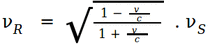 .
νR is the frequency in the detector coordinate system, νS is the frequency in the source coordinate system and v is the relative velocity between the detector and the source. v is positive if the distance between the detector and the source increases. This formula applies when velocity and wave are parallel.
.
νR is the frequency in the detector coordinate system, νS is the frequency in the source coordinate system and v is the relative velocity between the detector and the source. v is positive if the distance between the detector and the source increases. This formula applies when velocity and wave are parallel.