Tutorial : spherical refracting surface - Weierstrass points position
Rigorous stigmatism
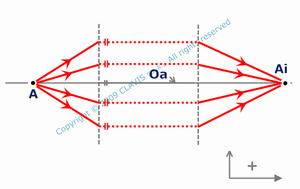 Considering an optical system, the stigmatism between two points A and Ai is realized when all rays from the object A are focusing on its image Ai after propagation through the optical system.
The stigmatism can be approached. It is for instance the case for most of the optical systems working in Gauss conditions (see "paraxial parameters" and "paraxial conjugation" tutorials).
The stigmatism can be rigorous for some special optical systems and particular object positions. According to the Fermat principle, when rigorous stigmatism occures, the optical distance from the object to its image is constant whatever the rays considered.
The most common configurations for rigorous stigmatism are detailed in the next sections of this tutorial. they include the following cases : spherical dioptres working for Weiesrtrass points as object and image, ellipsoidal mirror working for its focal points as object and image, parabolic mirror used for focusing a collimated beam.
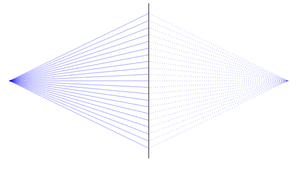 There is one optical component for which the stigmatism is rigorous whatever the object position : it is the flat mirror. Indeed, according to Snell-Descartes law (see tutorial on "refraction-reflexion on a dioptre"), the conjugate is the symmetric of the object with respect to the plane mirror. This is illustrated on the nearby ray tracing. Therefore, flat mirrors are aberration free. They are currently used for instance to make imaging systems more compact by folding them.
Also, all systems made of a single surface ( dioptres or mirrors) are rigorously stigmatic for all points of the surface. Indeed, each point of the surface is obviously rigorously conjugated with itself.
There is one optical component for which the stigmatism is rigorous whatever the object position : it is the flat mirror. Indeed, according to Snell-Descartes law (see tutorial on "refraction-reflexion on a dioptre"), the conjugate is the symmetric of the object with respect to the plane mirror. This is illustrated on the nearby ray tracing. Therefore, flat mirrors are aberration free. They are currently used for instance to make imaging systems more compact by folding them.
Also, all systems made of a single surface ( dioptres or mirrors) are rigorously stigmatic for all points of the surface. Indeed, each point of the surface is obviously rigorously conjugated with itself.
Weierstrass points of a spherical refracting surface
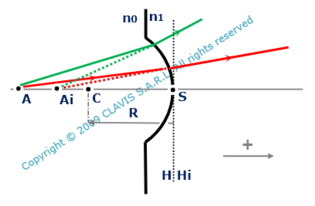 For a spherical dioptre, two singular points A and Ai on the optical axis are rigorously stigmatic : they are called the Weiestrass points (or Young points). According to the Fermat principle, they are calculated by imposing the optical path for rays coming from A and ending on the optical axis after refraction to be constant whatever the incident ray direction. This leads to the following formulas:
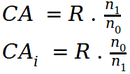 .
R is the radius of the dioptre and C is its center. n0 and n1 are the refraction indexes respectively before and after the dioptre.
CA and CAi are the algebric distances respectively from C to A and from C to Ai.
Therefore, for a convex dioptre (R negative) both Weierstrass points are on the left side of the center. This means that the object is real and the image is virtual. For a concave dioptre (R positive), object and image are on both sides of the dioptre. Depending on the refraction indexes, either the object or the image is virtual.
.
R is the radius of the dioptre and C is its center. n0 and n1 are the refraction indexes respectively before and after the dioptre.
CA and CAi are the algebric distances respectively from C to A and from C to Ai.
Therefore, for a convex dioptre (R negative) both Weierstrass points are on the left side of the center. This means that the object is real and the image is virtual. For a concave dioptre (R positive), object and image are on both sides of the dioptre. Depending on the refraction indexes, either the object or the image is virtual.
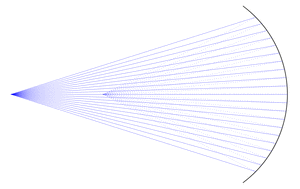 The rigorous stimatism of a dioptre is illustrated with the ray tracing on the left. In this case, R is negative. The object is the most distant from the dioptre ( n1 larger than n0).
Spherical dioptres working for Weierstrass points are for instance used in high aperture imaging systems (like microscope lenses) in order to reduce the aperture and correct more easily further aberrations.
The rigorous stimatism of a dioptre is illustrated with the ray tracing on the left. In this case, R is negative. The object is the most distant from the dioptre ( n1 larger than n0).
Spherical dioptres working for Weierstrass points are for instance used in high aperture imaging systems (like microscope lenses) in order to reduce the aperture and correct more easily further aberrations.