Tutorial : elliptical mirror - distance between Weierstrass points – given small and large axis
Rigorous stigmatism
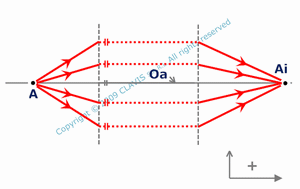 Considering an optical system, the stigmatism between two points A and Ai is realized when all rays from the object A are focusing on its image Ai after propagation through the optical system.
The stigmatism can be approached. It is for instance the case for most of the optical systems working in Gauss conditions (see "paraxial parameters" and "paraxial conjugation" tutorials).
The stigmatism can be rigorous for some special optical systems and particular object positions. According to the Fermat principle, when rigorous stigmatism occures, the optical distance from the object to its image is constant whatever the rays considered.
The most common configurations for rigorous stigmatism are detailed in the next sections of this tutorial. they include the following cases : spherical dioptres working for Weiesrtrass points as object and image, ellipsoidal mirror working for its focal points as object and image, parabolic mirror used for focusing a collimated beam.
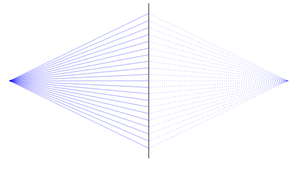 There is one optical component for which the stigmatism is rigorous whatever the object position : it is the flat mirror. Indeed, according to Snell-Descartes law (see tutorial on "refraction-reflexion on a dioptre"), the conjugate is the symmetric of the object with respect to the plane mirror. This is illustrated on the nearby ray tracing. Therefore, flat mirrors are aberration free. They are currently used for instance to make imaging systems more compact by folding them.
Also, all systems made of a single surface ( dioptres or mirrors) are rigorously stigmatic for all points of the surface. Indeed, each point of the surface is obviously rigorously conjugated with itself.
There is one optical component for which the stigmatism is rigorous whatever the object position : it is the flat mirror. Indeed, according to Snell-Descartes law (see tutorial on "refraction-reflexion on a dioptre"), the conjugate is the symmetric of the object with respect to the plane mirror. This is illustrated on the nearby ray tracing. Therefore, flat mirrors are aberration free. They are currently used for instance to make imaging systems more compact by folding them.
Also, all systems made of a single surface ( dioptres or mirrors) are rigorously stigmatic for all points of the surface. Indeed, each point of the surface is obviously rigorously conjugated with itself.
Weierstrass points of an elliptic mirror
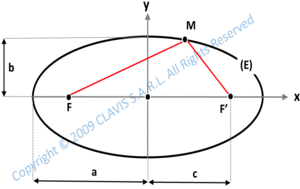 In the 2D space, an ellipse (E) is a curve defined by the set of points M satisfying the following equation:
  where F and F' are two carecteristic points called the focal points and a is the half length of the large axis of the ellipse. Optically speaking, if the ellipse is a mirror, whatever a ray coming from F, once reflected by a point M of the ellipse it passes through F'. Indeed, as he optical distance from F to F' is constant, the Fermat principle is verified. F and F' are also called the Weierstrass points of the elliptic mirror.
The equation of the ellipse in a coordinate system centered in the middle of the focal points is :
where F and F' are two carecteristic points called the focal points and a is the half length of the large axis of the ellipse. Optically speaking, if the ellipse is a mirror, whatever a ray coming from F, once reflected by a point M of the ellipse it passes through F'. Indeed, as he optical distance from F to F' is constant, the Fermat principle is verified. F and F' are also called the Weierstrass points of the elliptic mirror.
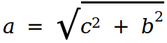
The equation of the ellipse in a coordinate system centered in the middle of the focal points is : 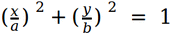 . As defined above, a is the length of the large axis. b is the length of the small axis. If c = |FF'| / 2 is the half distance between the two focal points F and F', the link between a and b is given by the formula below :
 .
.
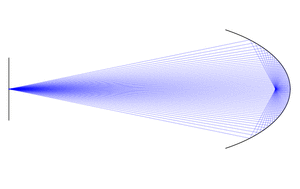
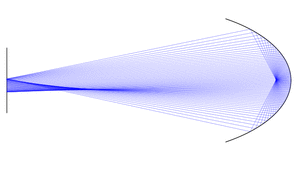 The rigorous stigmatism is illustrated in the leftmost ray tracing where the object is the focal point the nearest from the mirror and the image is the other one. Note that the rays can make a large angle with the ellipse axis (larger than 90 degrees). For this reason, elliptical mirrors with a large aperture are often part of illumination systems enabling to capt a lot of rays. For instance, elliptic mirrors are largely used in optically pumped lasers (like Nd:Yag lasers) for imaging pumping light source into the gain medium (see "laser" tutorials). Note also that any change in the object position induces aberration preventing from rigorous stigmatism as shown in the rightmost ray tracing.