laser
Laser basics
The first Laser ( Acronym of Light Amplification by Stimulated Emission of Radiation) has been realized in 1961 by Theodore Mainman. It is now a very common light source.
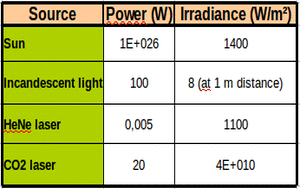 The laser differs from other light sources (called uncoherent light sources) first by the fact that it can have a very high spatial coherence. This means that its beam can be focused on a small area and therefore can have significantly higher irradiance compared to other sources, even much more powerful sources. The table nearby gives some rough values of irradiance for different types of sources and one can see for instance that a collimated beam from a few mW laser has an irradiance much higher than that of a 100 W incandescent light at 1 meter distance.
The second particularity of the laser is what is called the spectral coherence which is intimately linked to the spectral width of the laser. Indeed, a laser can have a spectrum much narrower than uncoherent sources. This small spectral width has many advantages as for example in spectroscopy applications for performing fine characterization of materials in different states (gas, liquid or solid), or in optical telecoms for transmitting informations with high data rates. This spectral finesse induces what is called a temporal coherence much higher than that of conventional sources. A large temporal coherence enables to make interfere beams travelling very different optical distances. This is an important property because interferometry is used in metrology and lasers have enabled for instance to realize very accurate motion and distance sensors with nanometric resolutions on very large amplitudes that are not possible to produce with other sources.
Laser amplification
Lasers are coherent light sources based on light amplification. Light amplification takes place by stimulated emission in what is called a gain medium. Gain media are made of atoms with at least two energy levels ( a high and a low energy level ). They can be gaseous (like in HeNe lasers, ion lasers like Argon or Krypton lasers, ...), liquid (like in dye lasers,...) or solid (like in laser diodes, fiber lasers, XX:YAG lasers, Ti:Sa lasers,...).
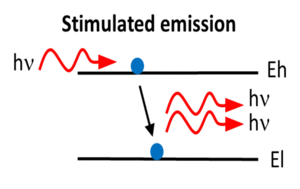 The stimulated emission is achieved when an atom in a high energy level absorbs a photon when emitting two photons and collapsing into its low energy level. All emitted photons have about the same wavelength corresponding to the energy gap of the transition. The rate of stimulated emission is given by the formula :
 .
N2 is the atoms density in the high energy level and W(u) is the probability that the transition occur by atom and by second with a flux u (number of photons per square meter and per second).
.
N2 is the atoms density in the high energy level and W(u) is the probability that the transition occur by atom and by second with a flux u (number of photons per square meter and per second).
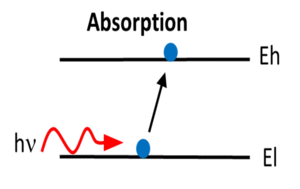 The stimulated emission is altered by the absorption of photons by atoms in the low energy level. The rate of absorption is given by :
 where N1 is the atoms density in the low energy level.
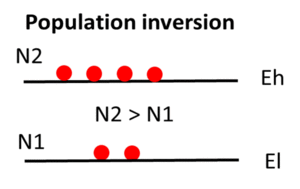 The amplification occurs when the stimulated emission effect is stronger than the absorption. This is achieved when the atoms density is larger in the high energy level than in the low one (
 ). This is called the population inversion.
Naturally, according to the Boltzman law, there are more atoms in the low energy level than in the high energy one. Consequently, the gain medium requests some exterior energy (pumping energy) for creating the population inversion and enabling the amplification. The type of pumping energy is different depending on the laser. It is mostly optical or electrical. It is optical for solid lasers like XX:YAG lasers where either flash lamps or laser diodes light is transmitted to and absorbed by the solid gain medium. It can be electrical like for most common semiconductor lasers where the energy is supplied by the current passing through the semiconductor. Electricity is also used in gas lasers by first ionizing the gas mixture and then maintaining a current though it.
). This is called the population inversion.
Naturally, according to the Boltzman law, there are more atoms in the low energy level than in the high energy one. Consequently, the gain medium requests some exterior energy (pumping energy) for creating the population inversion and enabling the amplification. The type of pumping energy is different depending on the laser. It is mostly optical or electrical. It is optical for solid lasers like XX:YAG lasers where either flash lamps or laser diodes light is transmitted to and absorbed by the solid gain medium. It can be electrical like for most common semiconductor lasers where the energy is supplied by the current passing through the semiconductor. Electricity is also used in gas lasers by first ionizing the gas mixture and then maintaining a current though it.
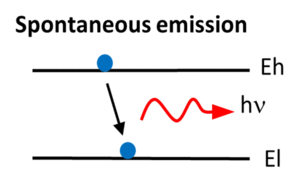 Another phenomenom exists in a gain medium : it is the spontaneous emission.
This happens when atoms in the high energy level emits a photon and collapse into the low energy level. Its rate is expressed below :
Another phenomenom exists in a gain medium : it is the spontaneous emission.
This happens when atoms in the high energy level emits a photon and collapse into the low energy level. Its rate is expressed below :
 .
A is the probability that spontaneous emission happens for one atom. Spontaneous emission is not part of the coherent light emission process and is considered as optical noise.
.
A is the probability that spontaneous emission happens for one atom. Spontaneous emission is not part of the coherent light emission process and is considered as optical noise.
The amplification alone is not sufficient to explain the laser behaviour. Indeed, the gain medium has to placed inside what is called a resonant cavity.
Laser cavity
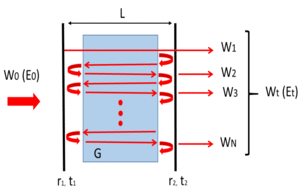 In the simplest configuration, the resonant cavity is a Fabry Perot made of two mirrors (see "Fabry Pertot" tutorial). At least, one mirror is not completely reflective. Therefore, it can transmit part of a light wave travelling inside the cavity and works as what is called the output coupler. Lets consider an incident light wave W0 (amplitude E0)on the Fabry Perot. It is amplified by the gain medium and partly reflected back and forth by the mirrors. Like in a Fabry perot interferometer, the output wave Wt (amplitude E0) is the combination of the wave W1 directly transmitted by the output coupler, the wave W2 transmitted after one round trip, the wave W3 transmitted after two round trips, ..., the wave Wn transmitted after n round trips, etc.
The transmission in amplitude is :
 .
.
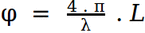 is the phase shift after one round trip and r1, t1, r2, t2 are the reflection and transmission coefficients in amplitude respectively of the first and second mirrors.
Unlike Fabry Perot interferometers, there is no incident wave in a laser cavity : the wave is generated inside the gain medium. Therefore, the laser emission can only happen if :
(1)
is the phase shift after one round trip and r1, t1, r2, t2 are the reflection and transmission coefficients in amplitude respectively of the first and second mirrors.
Unlike Fabry Perot interferometers, there is no incident wave in a laser cavity : the wave is generated inside the gain medium. Therefore, the laser emission can only happen if :
(1)  .
The imaginary part of the expression above must be null, therefore
.
The imaginary part of the expression above must be null, therefore  which means that the wavelengths λk (longitudinal modes) emitted by the laser are modes of the Fabry Perot :
 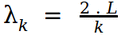 .
The corresponding frequency is
.
The corresponding frequency is  . Therefore, the distance between two consecutive longitudinal modes in the frequency space is :
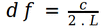 . It is constant.
Equation (1) can be written
. It is constant.
Equation (1) can be written  . When squared, this equality gives :
 .
Thus, not only the phase but also the intensity remains the same after one round trip in the cavity. In other words, the amplification by the gain medium after one round trip compensates the losses by the mirrors.
The last condition for a wave to be emitted by a laser is that its spatial intensity distribution remains the same after one round trip in the cavity otherwise no interference can happen. This means that the cavity is stable. The condition for a stable cavity is :
.
Thus, not only the phase but also the intensity remains the same after one round trip in the cavity. In other words, the amplification by the gain medium after one round trip compensates the losses by the mirrors.
The last condition for a wave to be emitted by a laser is that its spatial intensity distribution remains the same after one round trip in the cavity otherwise no interference can happen. This means that the cavity is stable. The condition for a stable cavity is :
 where
where  . L is the optical distance between the mirrors, R1 and R2 are the radii of the mirrors.
There are many different types of cavities. For simplicity, only two mirrors cavities have been considered but more complicated cavities like for instance ring cavities or Z shape cavities can be used.
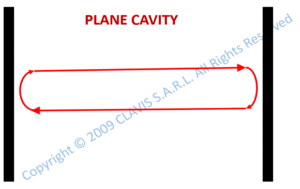
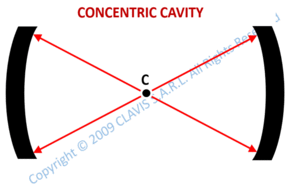
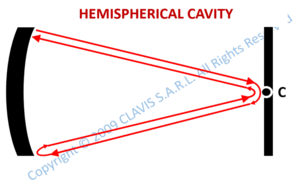
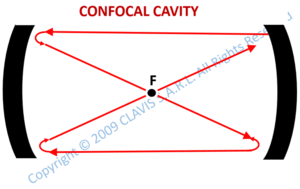
The most common ones using two mirrors are presented in the schemes below. Note that for plane and concentic cavities, L is the distance between the mirrors while its twice the distance for confocal and hemispherical cavities.
. L is the optical distance between the mirrors, R1 and R2 are the radii of the mirrors.
There are many different types of cavities. For simplicity, only two mirrors cavities have been considered but more complicated cavities like for instance ring cavities or Z shape cavities can be used.
The most common ones using two mirrors are presented in the schemes below. Note that for plane and concentic cavities, L is the distance between the mirrors while its twice the distance for confocal and hemispherical cavities.
 The laser spectrum depends not only on the resonant cavity but also on the gain medium. Indeed, The gain is not uniform depending on the wavelength and enables the population inversion only on a limited spectrum. Finally, one or a few longitudinal modes are generally emitted as shown on the left picture (the spectrum is represented in the frequencies space and df is the distance between two consecutive modes). It is possible also to select only one longitudinal mode in order to emit a very coherent light. Depending on the technology, single longitudinal mode lasers can for instance have a coherence length of several kms.
Laser beam
Geometric optics is not sufficient to explain light emission by a laser. Electromagnetic theory with limit conditions given by spatial and phase stabilities after one round trip in the cavity impose that only specific waves can oscillate. They are called the transverse modes of the laser. In Gauss conditions, they are solutions of the Maxwell equation in isotropic media using the paraxial approximation :
 .
Among others, these waves depend on the mirrors shape and their relative positions. Different models exist depending on the cavity. The models pedict modes with different kinds of intensity distributions. If the mirrors have a rectangular symetry, Hermito gaussian modes may propagate. The amplitude of the Hermito Gaussian mode Hpq is given by :
.
Among others, these waves depend on the mirrors shape and their relative positions. Different models exist depending on the cavity. The models pedict modes with different kinds of intensity distributions. If the mirrors have a rectangular symetry, Hermito gaussian modes may propagate. The amplitude of the Hermito Gaussian mode Hpq is given by :
 .
.
 is an Hermite polynomial.
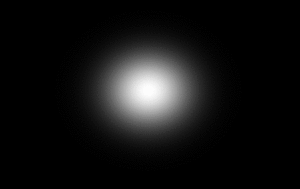
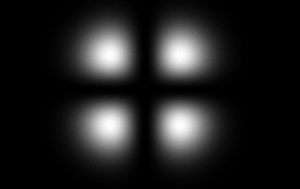
The intensity distribution of Hermito gaussian modes H00, H11, H21 and H22 are illustrated below.
is an Hermite polynomial.
The intensity distribution of Hermito gaussian modes H00, H11, H21 and H22 are illustrated below.
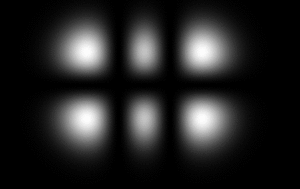
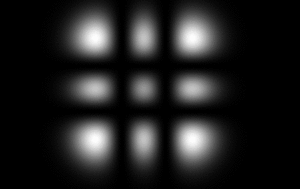
In cavities with a cylindrical symetry, Laguerre gaussian modes may propagate. The amplitude of the is given by the formula below :
 .
.
 is a Laguerre polynomial.
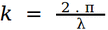
Among all the modes, the fundamental mode (common to Hermito gaussian and Laguerre Gaussian modes) is also called TEM00 mode or gaussian mode because its intensity distribution in a transverse plane XY perpendicular to the propagation has a gaussian shape. Its amplitude distribution is :
is a Laguerre polynomial.
Among all the modes, the fundamental mode (common to Hermito gaussian and Laguerre Gaussian modes) is also called TEM00 mode or gaussian mode because its intensity distribution in a transverse plane XY perpendicular to the propagation has a gaussian shape. Its amplitude distribution is :
 .
.
 ,
,  ,
,  ,
,  ,
, 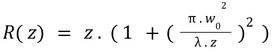 .
R(z) is the radius of curvature of the wave front at the distance z from the waist.
The intensity is:
.
R(z) is the radius of curvature of the wave front at the distance z from the waist.
The intensity is:
 .
.
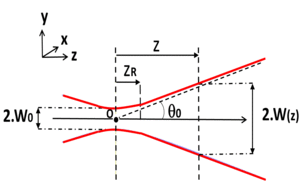
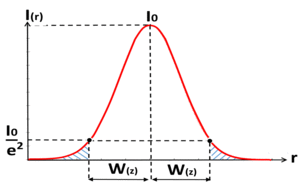 Whatever the transverse plane, the beam is commonly delimited by the circle for which the relative intensity is 1 / e2 and therefore containing 86,5% of the light power. This circle diameter is 2 .w(z) and is defined as the beam diameter at the considered position on the propagation axis. The beam diameter changes along the propagation axis and forms an hyperboloidic envelope . The beam half divergence is
 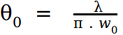 . The origin O of the propagation axis is taken on the waist where the beam cross section is the smallest.
The half diameter of the waist is w0.
The Rayleigh range defined by 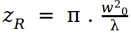 is a characteristic parameter of the beam.
if
is a characteristic parameter of the beam.
if  , the considered zone is commonly called the "near field " and
 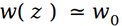 . The wavefront shape is rather flat.
if
. The wavefront shape is rather flat.
if  , the considered zone is commonly called the "far field" and
  . The beam is diverging and the wavefront is spherical and approximately centered on the waist center.
The fundamental mode is the less diverging mode and thus it has the highest spatial coherence. Therefore, most laser suppliers try to manufacture lasers emitting in the fundamental mode only.
In reality, laser beams can never be exactly gaussian, first because the involved theory is an approximation in the paraxial conditions, second because the cavity is not prefect (mirrors shape and positionning are not exactly as designed) or simply because the beam can not be fully cleaned and it is a combination of the gaussian mode with higher order modes. Whatever the beam, it has a waist (location where its cross section is the smallest) and a divergence which is necessarily larger than the divergence of the theoretical gaussian beam with the same waist radius.
. The beam is diverging and the wavefront is spherical and approximately centered on the waist center.
The fundamental mode is the less diverging mode and thus it has the highest spatial coherence. Therefore, most laser suppliers try to manufacture lasers emitting in the fundamental mode only.
In reality, laser beams can never be exactly gaussian, first because the involved theory is an approximation in the paraxial conditions, second because the cavity is not prefect (mirrors shape and positionning are not exactly as designed) or simply because the beam can not be fully cleaned and it is a combination of the gaussian mode with higher order modes. Whatever the beam, it has a waist (location where its cross section is the smallest) and a divergence which is necessarily larger than the divergence of the theoretical gaussian beam with the same waist radius.
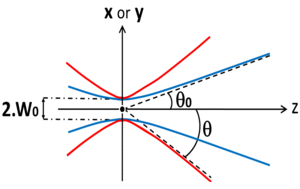 A simple way to modelize the propagation is then to consider the beam as an "embedded" gaussian beam with an hyperboloidic shape and which divergence is given by θ with
 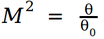 . The M2 factor (or "M-square" factor) is therefore larger than 1. The "embedded" gaussian beam parameters can be calculated using the fundamental mode formulas and replacing
  .
For example, the beam rayleigh range becomes
.
For example, the beam rayleigh range becomes 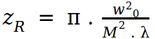 .
.
M2 can be specified smaller than 1.05 for relatively low power lasers and can achieve several dozens for high power lasers. Note that the concept of low or high power is strongly dependant on the technology. For example, Argon lasers can have low M2 (close to 1) with power in the range of 20 W while laser diodes are generally multimode at power of a few Watts and even less.
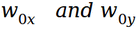
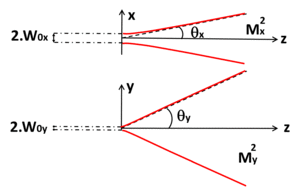 There are cases where the gain medium as well as the mirrors have a rectangular symetry as for instance in semiconductor lasers which gain medium is a parallelipipedic waveguide. The fundamental mode can then be modellized as gaussian in the XZ and YZ planes with different waist dimensions
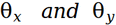
  and different divergences
  ....
For embedded gaussian beams, the "M-square" factors M2x and M2y are defined respectively in the XZ and YZ planes.
....
For embedded gaussian beams, the "M-square" factors M2x and M2y are defined respectively in the XZ and YZ planes.
Obviously, M2x and M2y can have different values. For example, high power laser diodes made of a single wave guide (emitting few Watts) have a thickness (in the range of hundred microns) very different from the height ( in the range of the micron) and thus the M2y corresponding to the vertical plane is close to 1 while M2x corresponding to the horizontal plane is much higher than 1. Note that all semiconductor lasers don't have astigmatism. For example VCSELs (Vertical Cavity Surface Emitting lasers) can emit beams with a cylindrical symetry.
Laser beam shaping
In many cases, laser beams can not be used directly without being transformed. For example, a collimated beam naturally emitted by a Nd:Yag laser for material drilling generally requests to be focused both to obtain the desired hole diameter and a higher brightness. Also, a collimated laser beam from an Argon laser can not be efficiently coupled into a fiber optics which core diameter is generally smaller. It needs to be adequately focused on the fiber entrance. A semiconductor laser beam is naturally diverging and has to be first collimated and secondly focused on the fiber entrance to be injected efficiently. These examples are only a few and there are many others.
A gaussian beam after an optical surface in the paraxial approximation can be calculated thanks to the ABCD matrix used for paraxial conjugation.
In paraxial conjugation,  =
=  X
X  where ABCD is the propagation matrix from a plane P1 to another plane P2.
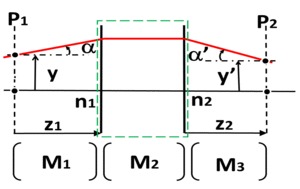 Considering an optical system between the two planes P1 and P2, the ABCD matrix is M3xM2xM1 where M1 is the propagation matrix from P1 to the primary principal plane, M2 is the propagation matrix through the optical system from the primary principal plane to the secondary principal plane and M3 is the propagation matrix from the secondary principal plane to P2.
M1 =  and M3 =
  .
n1 and n2 are the refraction indexes respectively before and after the optical system. z1 is the distance from P1 to the primary principal plane. z2 is the distance fom the secondary principal plane to P2.
The matrix M2 corresponding to the most common optical components are :
.
n1 and n2 are the refraction indexes respectively before and after the optical system. z1 is the distance from P1 to the primary principal plane. z2 is the distance fom the secondary principal plane to P2.
The matrix M2 corresponding to the most common optical components are :
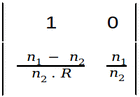 (spherical dioptrum),
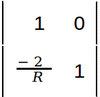 (spherical mirror),
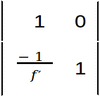 (thin lens)
The ABCD matrix can be used to calculate gaussian beams propagation. Let define Q(z) the complex curvature of the gaussian wave.
(thin lens)
The ABCD matrix can be used to calculate gaussian beams propagation. Let define Q(z) the complex curvature of the gaussian wave. 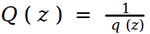 where .
The complex radii Q1(z) and Q2(z) respectively in P1 and P2 are corresponding by the formula :
(2)
where .
The complex radii Q1(z) and Q2(z) respectively in P1 and P2 are corresponding by the formula :
(2)  .
If z1 and z2 are the position of the waist respectively before and after the surface,
.
If z1 and z2 are the position of the waist respectively before and after the surface,  .
Q1(z) and Q2(z) are therefore imaginary.
.
Q1(z) and Q2(z) are therefore imaginary.
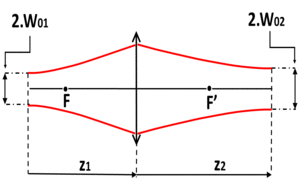 Knowing z1 and w01 (the waist position and its half diameter before the optical system), equation (2) allows to calculate z2 and w02 (the waist location and its half diameter after the optical system).
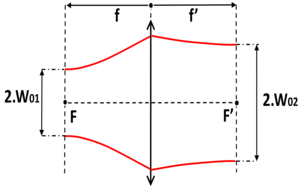 In the case of a thin lens, if the waist before the surface is located in the front focal plane, the waist after the lens is then located in the back focal plane and
 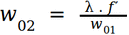 .
.
In these conditions, if w01 is small and thus the incident beam is diverging, w02 is large and the shaped beam has a small divergence. In the reversed situation where w01 is large and thus the incident beam is almost collimated, w02 is small and the transmitted beam is focused close to the back focal plane. Theses cases are quite similar to the cases encountered in geometric optics, the first one where the object is at the front focal plane and its conjugate is at infinity and the second one where the object is at infinity and its conjugate is at the back focal point.
For embedded gaussian beams, the calculation remains the same with :
 .
.
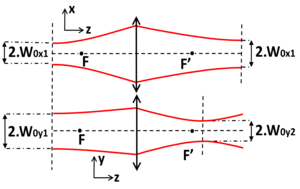 For elliptical beams, the calculations are realized similary but separately in each plane XZ and YZ plane with :
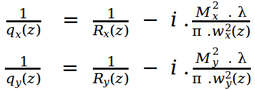 . Note that in general, the waists position after the optical system in the XZ and YZ plane may be different.
If the surface has no cylindrical symetry and is for example toroidal with Rx and Ry as radii respectively around X and Y axis, the transmission matrix M2x and M2y respectively in the XZ and YZ planes are :
M2x = 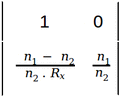 and M2y =
 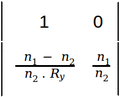 .
.
Different laser regimes
Lasers may have different regimes.
They can emit continuous waves (CW) such that the emitted power is constant. In this case, the pumping power is also constant.
They can be modulated. That is the case for laser diodes used for instance in optical communication. The modulated current enables then a modulated optical power.
Q-switching
Q-switching is a common mode for pulsed lasers. The cavity includes a Q-switch which is a component working schematically as an opened or closed gate. When the gate is closed, it introduces losses becoming then larger than the gain, therefore the population inversion can not occur and the laser wave can not propagate. However, the pump is still working so that the gain medium can store energy. When the gate suddenly opens, the losses become much lower than the gain and a powerful laser pulse is emitted. Among others, the energy per pulse depends on the pumping energy, on the gain medium, on the cavity, on the repetition rate and on the wavelength. The Q_switch can be an electromechanical device with an optical component enabling the cavity to be either aligned (opened gate) or misaligned (closed gate). Nowadays, acousto optics are mostly used as Q-switchs. Electro optics modulators requersting high voltage are also used for some low repetition rate and high power lasers.
Gain-switching
Gain-switching may be used for short pulse generation for instance in laser diodes. With a sufficient delay between the population inversion and the stimulated emission, the gain medium has time to store energy before emitting a short pulse. The pulse duration can be in the range of several tens of pico seconds for a laser diode.
Mode locking
Mode locked lasers are used to emit short pulses ( in the picoseconds or femtoseconds range ). In this case, the gain medium is able to amplify on a large spectral band. Thanks to a mode locker, longitudinal modes ( which can be numerous because of the large gain band ) can only oscillate at about the same time. When all the modes are synchronized, the minimum pulse duration is achieved and the time-bandwidth product is constant.
The pulse duration can be calculated from the time-bandwidth product as follows :
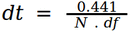 for a gaussian shape pulse and
 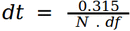 for a sech2 shape pulse.
dt is the pulse duration defined at Full Half Width Maximum (FWHM), df is the distance between two consecutive longitudinal modes expressed in the frequency space and N is the number of modes. Thus, the larger the emitted spectrum, the shorter the pulse.
The mode-locker can be for example a semiconductor saturable absorber mirror (SESAM) in the case of passive mode locking or an acousto optic or electro optic in the case of active mode-locking.
for a sech2 shape pulse.
dt is the pulse duration defined at Full Half Width Maximum (FWHM), df is the distance between two consecutive longitudinal modes expressed in the frequency space and N is the number of modes. Thus, the larger the emitted spectrum, the shorter the pulse.
The mode-locker can be for example a semiconductor saturable absorber mirror (SESAM) in the case of passive mode locking or an acousto optic or electro optic in the case of active mode-locking.
Laser power and energy
As said previously, in Continuous wave mode, lasers have a constant power over time.
 In other regimes, pulses are emitted. Useful parameters are then the repetition rate F which the frequency of the pulse emission, the average power P, the peak power Pp, the energy per pulse E and the duty cycle Duc. The duty cycle is the ratio of time during when the laser is emitting. All these parameters are calculated with simple formulas: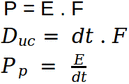
Note that the peak power formula considers that the power is constant during the pulse which is generally not the case. Therefore, it gives a rough value of the peak power: the real maximum peak power may be higher than the peak power calculated using the formula above with the same energy.
References
"Cours laser" - Institut doptique - 1986 - author: Pierre Cerez.
"Les lasers" - 1968 - author: M. Orszag.
"Cours laser et applications" - Institut Universitaire de Technologie Paul Cézanne - 2010 - author: Gilles Passedat.
"Cours résonateurs optiques et faisceaux gaussiens" - Ecole Nationale Supérieure des Télécommunications - 1988 - author: C.Debarge.
"Cours physique des lasers" - Ecole Nationale Supérieure des Télécommunications - 1988 - author: A. Migus.
"Cours sources à semiconducteurs" - Ecole Nationale Supérieure des Télécommunications - 1988 - author: J.C. Bouley.
"Understanding lasers" - 2008 - author: Jeff Hecht.
"Propagation des faisceaux gaussiens. transport des faisceaux de puissance" - Ecole d'été systèmes optiques - 2010 - author: A.Culoma.