plane dioptre
Refraction, refraction and absorption
At the interface between two media, light can be subject to three basic phenomena : refraction, reflexion and absorption. These phenomena can happen all together.
Optically speaking, a medium is basically defined by its refraction index which is the ratio  where n is the refraction index, c is the light velocity in the vacuum or in the air and v is the light velocity in the medium.
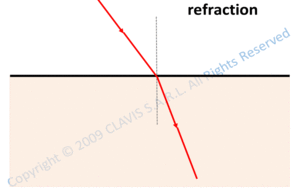 Light refraction is the deviation of rays when passing from a refracting medium (transparent medium) to another one with a different refractive index. The incident rays and the emerging rays are then going in the same way. Obviously, refraction does not happen if the second medium is not refringent.
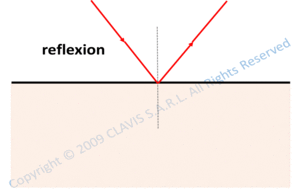 Light reflexion is the deviation of rays at the interface between two media so that the incident rays and emerging rays go in opposit ways. Therefore, obviously, the reflected rays don't go through the second medium. Reflexion may happen at the interface between two refringent materials. It happens also at the interface between a refringent material like for instance air and a non refringent one like for instance metal.
Light absorption is the transmission of the rays energy to the media. It is observed along the light propagation path and may result in a heating of the materials. Some absorption may occur also at the interface because an absorbing layer has been deposited or because of dust particles,etc. This may happen whatever the interface type (refringent/refringent or refringent/non refringent).
Refraction and reflexion laws
Refraction and Reflexion are both driven by the Snell-Descartes law :
 .
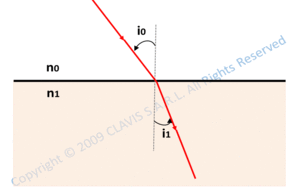
i0 is the incidence angle, i1 is the emergence angle, n0 and n1 are respectively the refraction indexes of the "incident" medium and of the "emerging" medium, the incident medium being the medium in which the incident ray is propagating and the emerging medium being the medium in which the emerging ray is propagating.
In case of refraction (left side scheme below), n0 and n1 are the refraction indexes respectively of the first and second media.
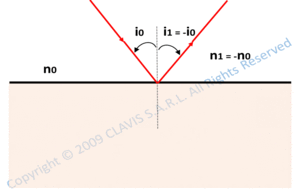
In case of reflexion (middle scheme below), n0 is the refraction index of the first medium and n1 = -n0. In consequence, the emergence angle i1 is opposite to the incidence angle i0 :
.
i0 is the incidence angle, i1 is the emergence angle, n0 and n1 are respectively the refraction indexes of the "incident" medium and of the "emerging" medium, the incident medium being the medium in which the incident ray is propagating and the emerging medium being the medium in which the emerging ray is propagating.
In case of refraction (left side scheme below), n0 and n1 are the refraction indexes respectively of the first and second media.
In case of reflexion (middle scheme below), n0 is the refraction index of the first medium and n1 = -n0. In consequence, the emergence angle i1 is opposite to the incidence angle i0 : 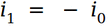 .
Considering two refringent media, according to the Snell-Descartes law, refraction is always possible when
.
Considering two refringent media, according to the Snell-Descartes law, refraction is always possible when  but is never possible when
  and
and 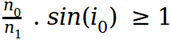 . In this case, total reflexion occure (no light is refracted).
 is the minimum incidence angle above which total reflexion happens (right side scheme below).
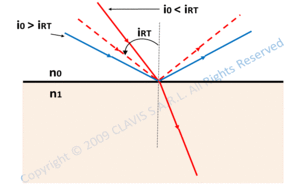
In general, if the total reflection conditions are not respected, both refraction and reflection happen. The amount of reflected and refracted light depend on the refraction indexes, on the incidence angle and on the light polarization. This aspect is treated in the "polarization" tutorial. Obviously, when the second medium is not refringent, refraction never occure.
References
"Optique Fondements et applications" - 2004 - author : José-Philippe Perez.
"Optique géométrique Imagerie et instruments" - 2007 - author : Bernard Balland.
"Optique géométrique paraxiale" - Institut doptique théorique et appliquée - 1985 - author : Michel Cagnet.
"Formation des images Aberrations" - Institut doptique théorique et appliquée - 1985 - author : Michel Cagnet.