
plane parallel plate
Introduction
A plane parallel plate in air or vacuum is made of two parallel surfaces separated by a transparent material.
Plane parallel plates are important components in optics. They can be used for instance as protection windows, beam splitters, polarizers (in reflexion at Brewster incidence angle) or dichroic filters thanks to spectrally filtering coatings. The refraction of light by a plane parallel plate can be calculated easily as both faces are plane and parallel (hence the name).
Ray shift induced by a plane parallel plate
 Rays refracted through a plane parallel plate are not deviated but only translated. The longitudinal shift of a ray is:
 .
.
i is the incidence angle, n is the refraction index and e is the thickness. The transversal shift is then :
 .
.
The shift in a plane perpendicular to the ray is :
 .
.
Therefore, all incident rays focused at a point A are shifted to the front after transmission through the plate at a distance dx from A depending only on the incidence angle i. This means that the plate generates spherical aberration ( see "spherical aberration" tutorial ).
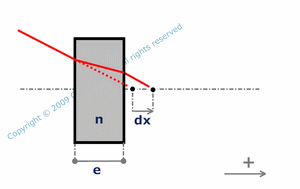 For sufficiently small incidence angles ( in Gauss conditions ), the longitudinal shift dx calculated above can be approximated as follows :
 .
.
dx is no more depending on the incidence angle. Therefore, the conjugate of a point by a plane parallel plate is a point shifted by dx. Note that the magnification is +1.
References
"Optique Fondements et applications" - 2004 - author : José-Philippe Perez.
"Optique géométrique Imagerie et instruments" - 2007 - author : Bernard Balland.
"Optique géométrique paraxiale" - Institut doptique théorique et appliquée - 1985 - author : Michel Cagnet.
"Formation des images Aberrations" - Institut doptique théorique et appliquée - 1985 - author : Michel Cagnet.