spectrum
Spectrum
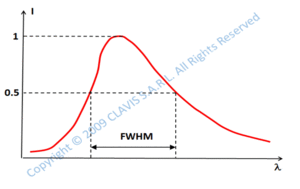 The spectrum of a light source defines the relative "quantity" of light emitted per wavelength (or per frequency). It is illustrated by a curve giving the relative intensity
(ordinate) emitted per wavelength or frequency (abscissa). The spectrum can be continuous as for thermal sources (like grey bodies) or discrete as for multimode lasers or luminescent sources. An important parameter defining the spectrum is the spectral width. Several definitions are used to specify the spectral width. It is often given by the
Full Width at Half maximum (FWHM) which is the distance on the abscissa between the wavelengths (or frequencies) with a relative intensity equal to half of the maximum value.
The spectrum of a light source defines the relative "quantity" of light emitted per wavelength (or per frequency). It is illustrated by a curve giving the relative intensity
(ordinate) emitted per wavelength or frequency (abscissa). The spectrum can be continuous as for thermal sources (like grey bodies) or discrete as for multimode lasers or luminescent sources. An important parameter defining the spectrum is the spectral width. Several definitions are used to specify the spectral width. It is often given by the
Full Width at Half maximum (FWHM) which is the distance on the abscissa between the wavelengths (or frequencies) with a relative intensity equal to half of the maximum value.
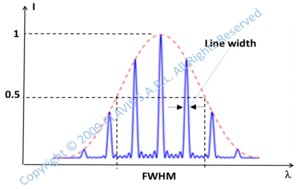 For luminescent sources or multimode lasers, there is a distinction between the spectral width and what is generally called the linewidth. The linewidth is the spectral width of a single mode emitted by a laser or of a single emission line of a luminescent source. More generally, the linewidth is used to define the spectral width of a light source with a narrow spectrum.
Any small spectral width or spectral shift can be converted from wavelength units to frequency units and vice versa according to the following formula:
 .
c is the light velocity in air or vacuum, λ is the wavelength and ν is the corresponding frequency.
The notion of spectrum is not only related to the light sources. Indeed, it can define the set of wavelengths that can be detected by a photodetector or transmitted by an optical system or component, etc.
An important phenomenom that can impact the spectral width is the Doppler-Fizeau effect. This phenomenom makes the frequency or wavelength received by a detector depend on the relative speed between the emitter and the detector. This phenomenom occurs on any wave type including electromagnetic waves and therefore light waves. This is for instance the major cause of linewidth enlargement of gaseous luminescent sources like for instance sodium sources. For electromagnetic waves, the shift between the frequency received by a detector (in the detector coordinate system) and the emitted frequency (in the coordinate system of the source) is given by the following formula:
.
c is the light velocity in air or vacuum, λ is the wavelength and ν is the corresponding frequency.
The notion of spectrum is not only related to the light sources. Indeed, it can define the set of wavelengths that can be detected by a photodetector or transmitted by an optical system or component, etc.
An important phenomenom that can impact the spectral width is the Doppler-Fizeau effect. This phenomenom makes the frequency or wavelength received by a detector depend on the relative speed between the emitter and the detector. This phenomenom occurs on any wave type including electromagnetic waves and therefore light waves. This is for instance the major cause of linewidth enlargement of gaseous luminescent sources like for instance sodium sources. For electromagnetic waves, the shift between the frequency received by a detector (in the detector coordinate system) and the emitted frequency (in the coordinate system of the source) is given by the following formula:
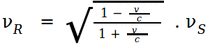 .
νR is the frequency in the detector coordinate system, νS is the frequency in the source coordinate system and v is the relative velocity between the detector and the source. v is positive if the distance between the detector and the source increases. This formula applies when velocity and wave are parallel.
.
νR is the frequency in the detector coordinate system, νS is the frequency in the source coordinate system and v is the relative velocity between the detector and the source. v is positive if the distance between the detector and the source increases. This formula applies when velocity and wave are parallel.
Light sources
There are essentially two kinds of light sources ( laser non included ).
Thermal light sources transform part of their thermal energy into light. They have a continuous spectrum and can generally be modelized with black body theory. Spectrum and
emitted power depend on light source temperature. Emitted power grows with temperature as maximum of the spectrum curve shifts to short wavelengths. Examples include sunlight
and tungsten light sources.
For luminescent light sources, a photon is emitted by an atom when collapsing from a "high energy" state ( excited state ) to a "low energy" state. Energy gap ( between low and
high energy states ) defines the emitted light energy and consequently its wavelength. As atoms have discrete energy gaps, a luminescent light source produces a discontinuous
spectrum made of emission lines. Naturally, atoms are mostly in "low energy" states. Light is emitted only if atoms have been excited first. Excitation can be electrical, optical,
acoustical, mechanical or thermal, depending on the light source. Examples include Mercury-vapor lamps and sodium lamps.
For luminescent light sources, FWHM on the global spectrum doesnt make sens but can be defined for each particular emission line. For emission line, spectrum width is
also called linewidth.
Relation between spectrum and pulse duration
For luminescent light sources and also lasers ( and without considering any spectrum broadening effects ) there is a relation between the minimum linewidth possible and
the natural lifetime of atoms in the excited state. It is given by the Heisenberg uncertainty principle. The larger the lifetime, the smaller the minimum linewidth.
As well, knowing spectrum of an emission line allows to calculate the minimum duration possible of a light pulse. This applies mainly for short pulse lasers
( mode locked lasers ) approaching this limit.
Doppler effect
 Applied to light, Doppler effect is the change in frequency ( fe and fr being the frequency respectively in
the light source and observer referentials ) of a light wave
for an observer moving relatively to the light source. This change depends on relative speed ( v ) between observer and light source but also on wave direction compared to
relative speed direction. This effect is mainly observed for light source made with gaz. Because of thermal excitation, atoms have different relative speeds with the
observer. Consequently, the observed spectrum is broadened. This spectrum broadening occurs on gaz luminescent sources but also on gaz lasers like HeNe lasers, ion lasers, etc.
Applied to light, Doppler effect is the change in frequency ( fe and fr being the frequency respectively in
the light source and observer referentials ) of a light wave
for an observer moving relatively to the light source. This change depends on relative speed ( v ) between observer and light source but also on wave direction compared to
relative speed direction. This effect is mainly observed for light source made with gaz. Because of thermal excitation, atoms have different relative speeds with the
observer. Consequently, the observed spectrum is broadened. This spectrum broadening occurs on gaz luminescent sources but also on gaz lasers like HeNe lasers, ion lasers, etc.
References
"Optique Fondements et applications" - 2004 - author : José-Philippe Perez.
"Cours doptique physique" - Institut doptique théorique et appliquée - 1985 - author : Christian Imbert.
"Cours doptique ondulatoire" - Université Denis Diderot Paris 7 - 2006 - author : G.Rebmann.
"Études graphiques des propriétés optiques des lames minces" - Journal de physique - 1950 - author : D. Malé.